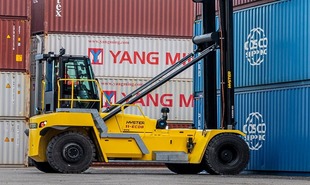
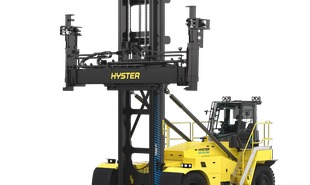
Hyster is delivering a battery-powered heavy-duty forklift to the Malta Freeport Terminals, which is powered entirely by 650-volt lithium-ion batteries. The machine is expected to significantly reduce greenhouse gas emissions at the Malta Freeport Terminals.
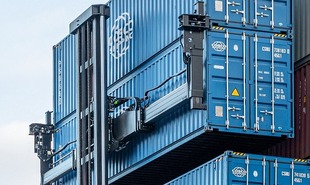
The device can stack eight empty containers individually on top of each other. This pilot project for battery-powered container handling is intended to help CMA CGM achieve its goals of accelerating the energy transition and becoming CO₂-neutral by 2050.
To achieve its decarbonization goal, the company has launched the "Pulse, CMA CGM Energy Fund." It covers all areas, including shipping, land transport, and logistics. The fund is intended to accelerate the decarbonization of all activities within the CMA CGM Group and its value chain. Pulse will finance Hyster's battery-electric empty container stacker under a two-year pilot agreement.
Alex Montebello, CEO of Malta Freeport Terminals Ltd: “The introduction of the electrically powered Hyster stacker for empty containers at Malta Freeport is an important step towards reducing emissions at our terminal operations. This is part of our commitment to eliminate carbon emissions by 2050.”
Niek Willems, Leader of Business Development, Global Ports and Terminals at Hyster: “CMA CGM has been one of Hyster’s global customers for more than ten years, and since 2016 it has been using our empty container stackers at its Malta Freeport terminals. We recently collaborated on the iTerminals 4.0 project, testing programs that leverage digitalization to explore smart maintenance options for port equipment. Our collaboration as pioneers in the introduction of the lithium-ion battery-powered empty container stacker is the next exciting step in this relationship.”
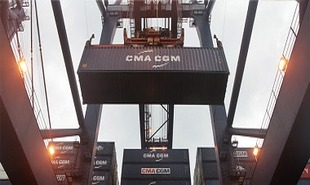 Photo: CMA CGM
The design of the electric empty container stacker for the Malta Freeport Terminals is based on the corresponding diesel model to provide operators with a familiar driving experience. The stacker's introduction follows pilot projects with a hydrogen fuel cell-powered top-pick container stacker at the Port of Los Angeles and a hydrogen fuel cell-powered reach stacker at the Port of Valencia. All of these innovative developments are aimed at transforming operations that previously relied on internal combustion engine forklifts.
Under the leadership of Rodolphe Saadé, the CMA CGM Group, with offices in 160 countries and a network of more than 400 branches, 750 warehouses, and a fleet of 620 vessels, connects customers to over 420 ports on five continents worldwide. In 2023, the group transported 22 million TEU containers (twenty-foot equivalent units). CMA CGM considers itself a pioneer in the use of alternative fuels.
Malta Freeport Terminals was established by the Maltese government in 1988. Following a privatization process in 2004, the government granted a 30-year concession for the operation and development of the terminal, which was later extended until 2069. The state-of-the-art terminal handles almost 3 million TEU containers annually and, following a €400 million investment program in infrastructure development, equipment, digitalization, and staff training, is one of the few facilities in the Mediterranean capable of handling Megamax vessels with a capacity of more than 23,000 TEU containers.
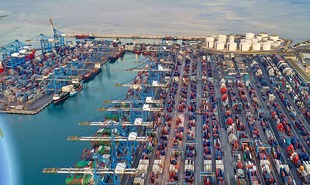 Photo: Malta Freeport Terminals
The company is currently jointly owned by Terminal Link, consisting of CMA CGM and China Merchants Port Holdings Company Ltd., and Yilport Holding Inc., Türkiye.