
The second edition of the Logistics Market Study 2024, recently published by the Institute for Supply Chain Management at the University of St. Gallen, explores some interesting questions. In addition to providing an in-depth overview of current trends, it also examines how much digitalization, despite the enthusiasm for progress, truly makes sense.
Download the full version at https://lms.gs1.ch/de
Following a foreword by Jan Eberle, Head of Industry Engagement Logistics at GS1 Switzerland, the team led by institute director Thomas Friedli, coordinator Leon Zacharias, and project manager Ludwig Häberle confirms Switzerland as an Eldorado for automation in warehouse logistics. This area is given its own dedicated section. Concise analyses are necessary to continuously monitor and evaluate market developments.
But not all trends, the compendium states, have a long-term impact; some are only of short-term significance, short-term flashes of brilliance triggered by singular events.
 Image: ISCM St. Gallen
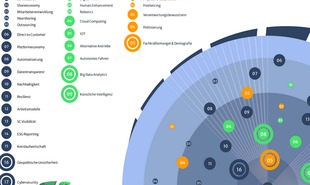
Of far greater significance, however, are Big Data and AI, which are establishing themselves as promising technological trends. Another category comprises lighthouse trends that are already recognizable today and are becoming increasingly relevant in the future, poised to have an impact on logistics as well.
Cybersecurity and sustainability reporting have both gained significant relevance. While sustainability reporting is now standard practice for listed companies and required, for example, for the allocation of investor funds, the requirements for ESG reporting are also increasing for SMEs. The international interconnectedness and business activities of companies play a role here. Those wishing to operate in other countries' markets are also bound by the legislation of those countries. For example, the introduction of the German Supply Chain Act has also led to changes for Swiss companies, such as those operating as suppliers to the German automotive industry.
The study also reflects on the sustainability of freight transport in Switzerland. According to the study, total greenhouse gas emissions in Switzerland amounted to 41.6 million tons of CO2 equivalents in 2022. This represents a decrease of 24% compared to 1990 and 7.8% compared to 2021. With a share of 32.9%, transport accounts for the largest share of all sectors.
Despite efforts over the past decades to achieve more environmentally friendly mobility, this situation has changed only slightly: While greenhouse gas emissions in the transport sector have decreased by 8% in absolute terms compared to 1990, the decline in emissions in other sectors began several years earlier, slightly increasing the relative share of the transport sector. With regard to domestic greenhouse gas emissions from transport, a trend reversal has occurred in recent years.
While traffic emissions were still rising at the beginning of the 2000s, the global economic crisis that began in 2008 marked a turning point, after which a continuous decline has been observed. This decline is driven by increasingly stringent emissions standards, the growing share of alternative drive systems in road transport, and – at least temporarily – reduced travel and increased working from home as a result of the COVID-19 pandemic.
Looking at the transport sector in isolation, car traffic dominates with over 70% of emissions
In second place is freight transport, accounting for over 21% of total traffic and almost 7% of Switzerland's total emissions. Emissions from rail, shipping, domestic air traffic, pipelines, the military, public buses, and fuel tourism are shown in the figures as "Other Transport," representing 4.12% of total traffic, and are considered to be of minor importance.
While passenger car traffic in 2022 was only slightly above the 1990 level (+0.5%) in terms of total greenhouse gas emissions, freight traffic emissions have increased by a good 19% since 1990, thus developing in the opposite direction to most other sectors and areas.
The driving force behind this is the more than doubled number of light vehicles (vans) used for road freight transport since 1990, and the resulting increase in mileage, which has risen by more than 60% in the period under review.
Light vehicles accounted for 41% of road freight emissions in 2022. Heavy vehicles (trucks and tractor units), on the other hand, exhibited the trend reversal seen across the entire transport sector around 2008 and have since reduced their emissions, accounting for 59% of road freight emissions in 2022.
Taking a look at the available figures from the logistics market study is worthwhile and highly recommended.
Download the full version at https://lms.gs1.ch/de