 Image: Swissmem
The situation for the Swiss tech industry remains strained. So far this year, sales have declined by 4.2 percent and goods exports by 3.6 percent. According to Swissmem, the reasons are the economic weakness in the EU, and particularly in Germany. Exports of conveyor and storage technology were down by 6.3 percent.
Compared to the same period last year, sales in the Swiss machinery, electrical, and metal industries fell by 2.4 percent. Looking at the entire nine months of this year, the decline in sales amounts to 4.2 percent. Order intake rose by 6.7 percent in the third quarter of 2024 compared to the same quarter of the previous year. At first glance, this might appear to indicate a trend reversal, but that is not the case. The increase is simply due to a base effect, as the previous year's quarter was exceptionally weak. In reality, order intake in the first nine months decreased by a total of 0.3 percent compared to the previous year. Capacity utilization also weakened further in the third quarter of 2024. At 82.9 percent, it was significantly below the long-term average (86.2 percent).
 Swissmem Director S. Brupbacher
Compared to the same quarter last year, exports from the tech industry declined by 2.5 percent in the third quarter. Looking at all three quarters of this year, exports fell by 3.6 percent year-on-year to CHF 50.8 billion. Germany is a major concern. Exports to the largest market for Swiss tech products fell by 8.4 percent in the first nine months. Exports to Italy (-7.2%), Austria (-5.0%), and France (-1.1%) also declined.
India remains the most dynamic sales market. Export volume to India rose by 11.0 percent from January to September 2024, with this positive trend accelerating further in the third quarter (+22.4%). However, these increases are insufficient to compensate for the weakness in other markets. Looking at individual product groups, only electrical engineering/electronics products recorded export growth of 1.0 percent in the first nine months. Exports of all other product groups declined (metals: -6.4%, mechanical engineering: -4.6%, precision instruments: -1.9%).
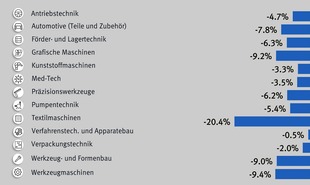 Exports from the tech industry, January to September 2024
Domestic demand is also weak. The difficult situation increasingly threatens to impact employment in the tech industry. "Our consultations regarding job cuts and short-time work have increased significantly in recent weeks," says Swissmem Director Stefan Brupbacher. "So far, only a few companies have reduced their workforce because they want to retain their skilled employees. However, I fear that short-time work and layoffs will now become more common.".
The latest survey of Swissmem member companies shows that the percentage of firms expecting a decline in orders from abroad over the next twelve months has increased from 25 to 33 percent. Only 28 percent of businesses now anticipate an increase in orders, while 39 percent expect orders to remain the same.
 Swissmem President M. Hirzel
“In the best-case scenario, we can expect a stabilization next year,” says Stefan Brupbacher. “Should a trade war break out between the US, China, and the EU, it would further drag down the Swiss tech industry, which exports 80 percent of its products.” If the new US president implements his announced tariff policy (tariffs of 60% against China, 10% to 20% against the rest of the world), this would have the potential to trigger dramatic consequences for the global economy.
“The free trade agreement with India must be ratified as quickly as possible,” demands Swissmem President Martin Hirzel. “It opens up substantial new market opportunities, especially for SMEs, in the dynamic growth market of India. Negotiations for a free trade agreement with the Mercosur countries must also be concluded now, and talks with the USA must be resumed.” He also expressed his hope for a favorable conclusion to the negotiations on the Bilateral Agreements III.
 Image: Swissmem
This coming weekend, the population will also vote on the expansion of the national highways, a project Swissmem strongly advocates. Hirzel: “We need a high-performance national highway network adapted to today’s needs. The highways handle 43% of the traffic volume with only 3% of the road surface. But thousands of employees in vans and trucks, and tens of thousands of commuters in cars on their way to work, are stuck in traffic jams for hours every day across Switzerland. (…) 48,000 hours of traffic jams (…) are incredibly uneconomical.”.
A "no" vote on adjusting the capacity of national roads will not benefit the climate: "Businesses will still have to deliver their goods – it will simply take longer and become even more expensive.".
the latest key figures for the Swiss tech industry in the third quarter. Download
klk./ Swissmem