 Nagra rock laboratory
A special type of packaging plant will be built in Würenlingen in connection with the search by the National Cooperative for the Disposal of Radioactive Waste (NAGRA) for the site of the geological deep repository Nördlich Lägern near the German border.
The deep geological repository is planned to consist of tunnels and caverns deep underground, with technical and geological barriers to contain the waste long-term. In recent years, Nagra has made increased efforts to be transparent. The northern Lägern ridge, it is said, is the best location with the greatest safety margins.
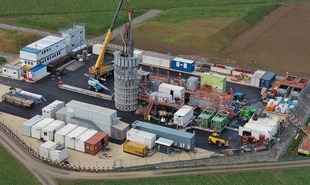 Exploratory drilling. Aerial photo: Nagra
The access tunnels to the repository are being built in the Haberstal valley in the municipality of Stadel (ZH). They extend more than 800 meters deep. The radioactive waste will be stored in the Opalinus Clay rock layer there. "We are convinced that we have found the safest location," says Nagra CEO Matthias Braun.
The gaps are filled
Low- and intermediate-level radioactive waste is solidified, packed into drums, and cast into concrete repository containers, which are then placed in caverns within the Opalinus Clay. The spaces between the containers are filled, and the caverns are sealed. The Opalinus Clay is largely impermeable to water, can self-seal cracks, and is capable of binding radioactive materials. The rock strata above and below the Opalinus Clay also contribute to the safe containment of the waste.
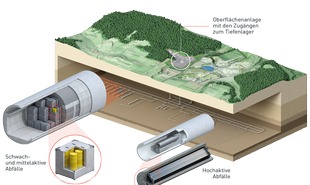
 Concept of the deep geological repository North Lägern
The high-level radioactive waste is packaged in storage containers and placed in tunnels. The tunnels are then filled with bentonite, a clay granulate with properties similar to Opalinus Clay: bentonite binds and encapsulates radioactive materials.
A crucial barrier for the high-level radioactive waste is the thick-walled repository container. It is designed to completely contain the waste for at least the first 1,000 years, during which time the radioactivity will decay significantly. In its application, Nagra proposes a maximum capacity of 2,500 cubic meters for the expected amount of waste, of which 880 cubic meters are reserved. Spent fuel elements constitute the largest share of the high-level radioactive waste.
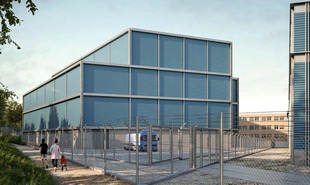 Extension building in Würenlingen. Graphic: Nagra
The amount of high-level radioactive waste generated in Switzerland depends largely on how long the nuclear power plants operate. Currently, this is not yet determined: the nuclear power plants may operate as long as they are considered safe. Nagra's models assume an operating life of 60 years for the existing nuclear power plants.
Application for maximum capacity
For low- and intermediate-level radioactive waste, a maximum volume of 100,000 cubic meters is proposed, with 55,000 cubic meters of this as a reserve. This waste originates partly from nuclear power plants – for example, contaminated protective suits or tools. It also arises from medical, industrial, and research settings.
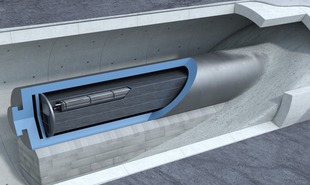 Multiple layers of protection
Among the most important buildings on the surface are the access structures to the deep geological repository, such as the shaft head facilities and the staging hall. There, the packaged waste is delivered and prepared for transport to the repository. Additional buildings are also required for the construction, operation, and logistics of the repository.
In its application, Nagra proposes the maximum dimensions for the most important buildings. For example, the application specifies an area of 80 by 50 meters and a maximum height of 25 meters for the storage hall.
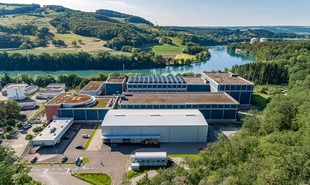
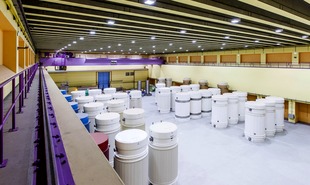 Interim storage facility in Würenlingen. Photo: Nagra
Because the repackaging of the waste does not take place at the deep geological repository site, a separate application is being submitted for the spent fuel packaging facility (BEVA). According to current plans, the low- and intermediate-level waste will also be packaged at the interim storage facility in Würenlingen (Zwilag) and then transported to the surface facility of the deep geological repository. A packaging facility already exists for low- and intermediate-level waste; only an increase in its capacity is needed.
Synergies with the ZwiLag
The construction of the BEVA facility at Zwilag will allow for the utilization of synergies. The site is already the center of expertise for the packaging of radioactive waste. The area does not need to be completely rebuilt, but merely expanded. A maximum footprint of 70 by 110 meters and a maximum height of 50 meters are proposed for the packaging plant.
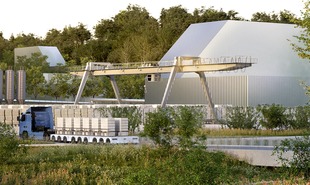 New capacities are to be created.
To expand the Zwilag site, Nagra proposes an integration zone and an installation area for construction site operations. The entire perimeter covers approximately 2 hectares. As with the surface facilities of the deep geological repository, the exact location and size of the buildings will be determined later with the building permit.
Due to the cross-border dimension of the project, Germany, the state of Baden-Württemberg and the municipalities in the Upper Rhine-Lake Constance region have been closely monitoring the Swiss repository process since its inception.
Switzerland has been using nuclear power for electricity generation since 1969. Currently, four reactor units are in operation (Beznau I, Beznau II, Gösgen, Leibstadt).
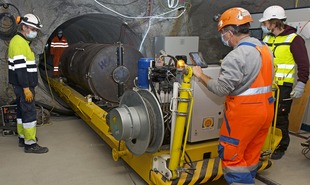
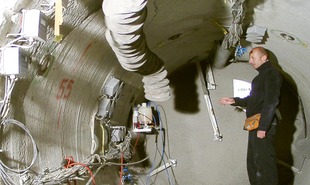 Nagra rock laboratory on Grimsel. Photo: klk.
Another reactor unit in Mühleberg was shut down in 2019. Following the Fukushima reactor accident in 2011, the Swiss government decided on a gradual phase-out of nuclear power. According to this decision, existing nuclear power plants may continue to operate as long as they are safe. However, they may not be replaced.
Perhaps notquite right in the head?
According to the 2021 waste disposal program, approximately 9300 cubic meters of high-level radioactive waste, approximately 72,300 cubic meters of low- and intermediate-level radioactive waste, and approximately 1000 cubic meters of alpha-toxic waste are expected to be generated during the assumed operating lifetime of the existing Swiss nuclear power plants.
In the Swiss rock laboratory at Grimsel, the effects of potential earthquakes, such as those that can occur from time to time on the High Rhine, were even investigated and assessed as minor.
However, there are also voices in Switzerland calling for another referendum on the planned deep geological repository. "Because it's not sealed," Harald Jenny, initiator of the "Nuclear Repository to the People" committee, told Swiss television SRF. "That means the material that's supposed to be buried there will begin to slowly but surely diffuse to the surface after about 10,000 years. We simply cannot expect future generations to live with that.".
klk.
Video from Swiss television SRF