Based on a design by star architect Helmut Jahn, ground was broken in 2000 for what was then Germany's tallest office building outside of Frankfurt, standing at 162.5 meters. It was ready for occupancy in 2002, housing 2,000 employees. Since then, the company, now a leading global logistics provider with 600,000 employees, has been managed from this location.
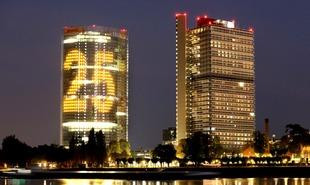
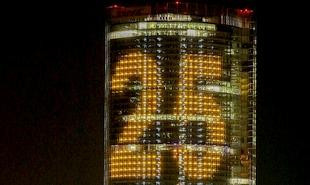
On August 21, 2000, the board of directors and high-ranking political representatives officially launched the construction of Deutsche Post's new corporate headquarters in Bonn. Thomas Ogilvie, Chief Human Resources Officer of the DHL Group, stated: "Even after a quarter of a century, the Post Tower stands for modernity, sustainability, and transparency."
“Greatness does not arise from the power of the individual, but from the work of many” – so reads the inscription on the foundation stone plaque in the 5th basement level of the Bonn Post Tower.
Transformation into a global corporation
Helmut Jahn certainly contributed his share. The new building was intended to mark the company's transformation from a national mail and parcel service provider to a globally operating logistics group on its way to the stock market.
At that time, Jahn was already known as the architect of the Messeturm in Frankfurt, the CitySpire Center in New York, the Xerox Center in Chicago, the Hitachi Tower in Singapore, and the Sony Center with Bahntower at Potsdamer Platz in Berlin. Countless other buildings, from the Shanghai New International Expo Centre (SNIEC) to the TK Elevator test tower, followed later.
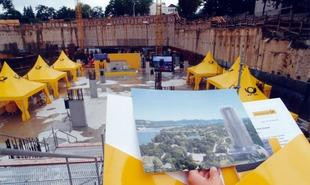
In 1997, Deutsche Post launched an architectural competition for the design of its new corporate headquarters in Bonn. The winners were selected in June 1998 by a diverse panel of experts including architects, representatives of the company, the city of Bonn, and politicians: Paul Böhm, Murphy/Jahn, and Joachim Schürmann – from these three prize winners, one had to be chosen. A year later, Helmut Jahn was selected. His design was deemed the most suitable of the three winners by the Deutsche Post board, the city of Bonn, and the city council factions.
Futuristic air conditioning
The Post Tower consists of two halves. The northern and southern semi-ellipses are separated by a 7.20 m wide gap. A steel and glass structure connects the two halves. The glass facade ensures a high proportion of natural sunlight inside. Twelve high-speed elevators transport employees and visitors to the 41 floors.
When constructing the Post Tower, the client, Deutsche Post, prioritized two things in the architecture: the comfort of the approximately 2,000 workplaces and low energy consumption. Sophisticated climate control technology ensures that the Post Tower does not require air conditioning.

Temperature regulation is achieved through the building's double glass facade and a 210 km long network of pipes through which water is pumped. Air exchange occurs via ventilation flaps in the double-walled outer facade, which control the airflow depending on the outside temperature. "The tower breathes in the wind," the architect, who passed away in 2021, described it. As a result, the high-rise requires an average of 30 percent less energy than comparable buildings.
"The tower breathes in the wind"
A particularly striking feature of the Post Tower is the light installations on its facade. Symbols appear on special occasions, such as a treble clef for the Beethoven Festival or a Christmas tree during Advent. These light installations are made possible by 2,000 lights mounted in the space between the double facade and controlled by a central computer. Employees can enjoy meals in the staff restaurant located in the adjacent base building.
The people of Bonn are also well aware of the Post Tower as a venue for cultural highlights such as the annual Bonn Jazz Festival or the LOL cabaret series by Springmaus.
Public guided tours of the building last approximately one hour and are available in German and English.
www.dhl.com