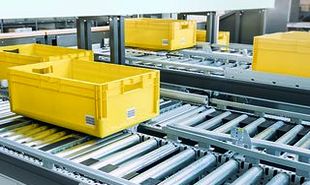
Updated conveyor technology methods are intended to increase efficiency at SSI Schäfer. For example, to speed of the motor rollers adjusts the current throughput (speed on demand) . The control system, electronics, and maintenance strategy meet the modern requirements of Industry 4.0 the.
SSI Schäfer has further developed its carton and container conveying technology, thereby significantly increasing energy efficiency and system availability.Proven technologies have been refined and simultaneously integrated into a modern design. Modern conveying technology must simplify processes, enable smooth material flows, and efficiently and promptly supply the various storage areas with the right goods. It should sort, feed in and out, store, and accumulate load carriers.
According to the manufacturer, the new carton and container conveyor system is suitable for small load carriers up to 50 kg, such as containers, cartons, trays, and polybags, which can be transported not only in single-type but also mixed on the conveyor system. Thanks to an intelligent and modular design, the coordinated conveyor components can be individually combined, giving customers a highly flexible and scalable overall system. It can even be used in deep-freeze environments down to -28°C.
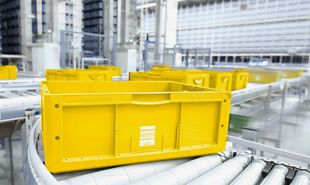
SSI Schäfer points to more than 15 years of experience and expertise in conveyor technology and a multitude of successful projects, in which over 1,000 km of conveyor technology have been sold and installed to date. In times of climate change, topics such as sustainability and energy saving are becoming increasingly important. "The latest generation of carton and container conveyor technology from SSI Schäfer therefore consumes significantly less energy than before – while simultaneously increasing throughput," says Product Manager Christian Steiner. "This is made possible by CAN bus technology, smart controls, and 48-volt drive technology. Smaller cable cross-sections and longer cable lengths result in reduced line losses at the same power output, as well as increased energy efficiency through larger and more efficient power supplies."
According to the company, the increased hardware performance, the new control system, and the intelligent combination of components result in a throughput increase of up to 30%. Furthermore, the slimmer roller design and the resulting reduction in plastic waste allow SSI to avoid approximately 31 tons of CO2 emissions per year. The aforementioned Speed on Demand function, which allows the speed of the motor rollers to be adjusted to the current throughput, will contribute to increased energy efficiency in the future.
A new control unit for the motor rollers, in conjunction with CAN bus technology, provides the basis for networked data exchange between systems and thus for a predictive maintenance strategy. "By capturing, analyzing, and evaluating plant-specific data in the SSI CMMS (Computerized Maintenance Management System), predictions of individually defined maintenance intervals will be possible in real time," says Steiner.
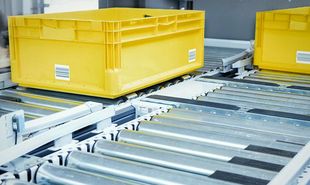 Photos: SSI Schäfer
In combination with the control software, the system's functionality can be extensively parameterized, even during operation. Thanks to visualization with the WAMAS Warehouse Management System (Lighthouse version), warehouse data is made transparent and visible in real time. A central standard interface connects both the new carton and container conveyor technology and all other conveyor systems in the warehouse to the MFS material flow system.
High-quality components ensure a long service life. The new motor roller features a durable, break-resistant roller design, and the belt pusher's lifting carriage has been given a more robust kinematic construction. The new conveyor technology also boasts roller conveyor finger guards and reduced noise emissions thanks to the use of pneumatic-free technology. A standardized plug-and-play connector system and streamlined wiring simplify installation and maintenance.
According to SSI Schäfer, after the considerable innovation effort, the system "utilizes the potential of digitalization and is optimally aligned with Industry 4.0 and the requirements of the future".