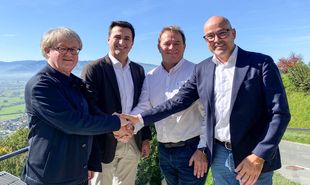
 R.Vockenhuber, M.Köb, R.Aschauer, Th.Pichler (vl)
World market leader Doppelmayr takes over the Austrian body and cabin manufacturer Carvatech – and can also book another order from Mexico City these days for the construction of a second cable car line as part of urban public transport.
Carvatech, like CWA, which has been part of the group since 2001 and is based in Olten, will remain an independent brand. With the acquisition by Doppelmayr, Carvatech's search for a successor due to the owners' retirement has also come to a successful end. Doppelmayr and the Oberweis-based body and cabin manufacturer have a long-standing and reliable partnership. Carvatech products have already been successfully used in numerous aerial tramways, funiculars, and gondola lifts. The merger, it is said, will elevate this collaboration to a new level.
Thomas Pichler, Managing Director of Doppelmayr Holding: “Carvatech is a profitable company that is ideally positioned in the market. We are convinced that the merger will bring new impetus and valuable synergies to our business. We thank the owners of Carvatech, Robert Vockenhuber and Reinhard Aschauer, for their trust and welcome the new Managing Director, Christoph Spiesberger, and the Carvatech team to the Doppelmayr Group.”
Vockenhuber and Aschauer agree: “In recent months, we proactively approached Doppelmayr because we believe that combining our strengths would be beneficial for both sides. As part of the search for a successor, our highest priority was to hand over our company to capable hands – hands that promise stability and success. We are firmly convinced that we have achieved this.” Carvatech manufactured its first cable car cabins back in 1956. Currently, the company employs around 50 people.
Next order from Mexico City
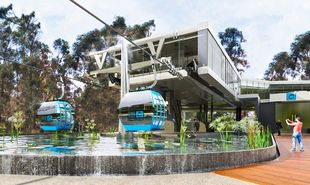
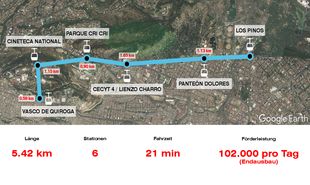
Doppelmayr has also secured a second major contract for the construction of an urban cable car system in Mexico City. The third line, "Cablebús Línea 3," will connect the Los Pinos and Vasco de Quiroga districts along a 5.42-kilometer route. A total of six stations, four of them located at the popular Chapultepec Forest, will provide boarding and alighting points along the way. Starting in December 2023, both residents and tourists will benefit from this attractive mobility solution. Doppelmayr was also responsible for the first "Cablebús" line in Mexico City, which was completed in 2021.
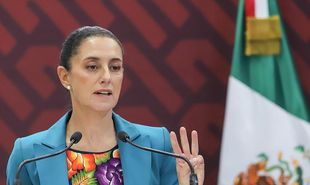 C. Sheinbaum Pardo
Mexico City's decision-makers aim to improve public transportation and increase the city's appeal to tourists with the construction of Cable Bus Line 3. Preparatory work for Line 3 began at the end of September this year. According to Jesús Antonio Esteva Medina, Mexico City's Secretary of Public Works and Services, the residents of the Santa Fe area will benefit most from the project. It will also connect to the Interurban Train (Tren Interurbano), currently under construction, and the Metro Constituyentes station. Line 3 is scheduled for completion in December 2023.
Second D-Line
The transportation project in Mexico City will again utilize detachable gondola lifts of the D-Line cable car generation. The total distance of 5.42 kilometers will be covered in approximately 21 minutes using six stations, 37 towers, and 71 Omega V cabins, traveling at a speed of 6 m/s. Each cabin is equipped with ten seats, providing ample space for passengers who can use the integrated Wi-Fi during the ride. Around 12 million passengers per year are expected to benefit from the new connection once completed.
 Photos: Doppelmayr
Claudia Sheinbaum Pardo, Mayor of Mexico City: “With this line, we aim to boost both mobility and tourism. For example, it will make it easier to visit the eleven cultural projects associated with the Chapultepec ‘Nature and Culture’ project, as well as the four sections of the Chapultepec green space. Line 3 is a fantastic project.”
Konstantinos Panagiotou, CEO of Doppelmayr Mexico: “We have already seen that the cable bus works. Lines 1 and 2 have a positive social impact, increase local safety, and stimulate the economy around the stations. Furthermore, the system produces no emissions and offers comfortable and reliable mobility. I am convinced that with Line 3, we are taking a major step closer to transforming Mexico City's public transportation system towards greater sustainability.”