Mobile transport robots save employees long distances and support workers in assembly. "Many are aware of the advantages – what's missing is an understanding of which transport processes are suitable for automation with mobile robots," explains Gérôme Stemmer, Head of Sales at Safelog. And he goes on to explain the range of possibilities.

Safelog categorizes application examples into Pick, Move, and Assemble. The "Pick" section lists all order picking processes in the warehouse. Both the "goods-to-person" and "person-to-goods" principles are equally considered. In the "goods-to-person" variant, mobile robots supply employees in the picking zone with pallets and containers from which the goods are picked. The process is monitored at specific points using patented pick-by-light and put-to-light solutions. The system alerts the worker to any errors during order processing. Picking can only continue once the error has been corrected. This is based on a consistent zero-defect strategy. After removal, the robots transport the empty containers, or those containing remaining stock, back to the warehouse.
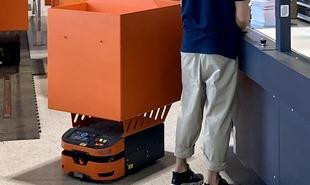 "At your feet!" at Sport Okay
In the "man-to-goods" principle, the employee follows the robot, which always stops at the specific shelf location where an item needs to be picked and processed. The vehicle can also provide visual support for the process using a pick-by-projector system. The pick is confirmed, and the robot-worker team moves on to the next area. Alternatively, the employee can be assigned to a specific zone. In this case, the robot comes to the employee and again stops at the relevant shelf location. The employee goes to the vehicle, places the item to be picked in a box on the robot, and confirms the action. This targeted picking process eliminates unproductive walking around the aisles.
From the "source" to the "sink"
The "Move" category encompasses all transport of a payload, whether on a pallet, in a wire mesh box, or in a container. For example, material can be moved from the end of a production line to a storage rack, or workpieces can be moved through the factory and then integrated into production.
For recurring transport from the "source" to the "destination," the forklifts that have dominated the warehouse landscape for decades are being gradually replaced. At the same time, workplace safety is being significantly improved, because dangerous situations inevitably arise where forklift drivers are present – for example, when a worker crosses their path. With mobile robots, this danger is eliminated through the use of various safety technologies.
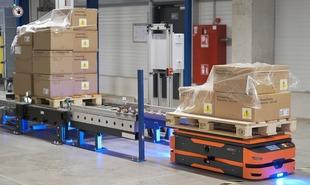 Handover to the conveyor system. Photos: jl /safelog
In buffer zones during loading and unloading, the robots' work begins as early as goods receiving. There, trucks are unloaded by a forklift, and the pallets are taken to a transfer point where an employee scans the goods, triggering a transport order for the mobile robots. These robots then immediately move the goods to the next buffer zone. Each robot knows what it has loaded and where to place or transfer it. The vehicle can also receive additional information about the transported goods, such as the weight of the load or the type of load carrier. As part of a sales partnership with the automation specialist Stäubli, Safelog will offer the FL1500 counterbalance forklift from the second quarter of 2025. This model can prepare goods for loading and perform a vertical transfer from a platform to the ground and vice versa.
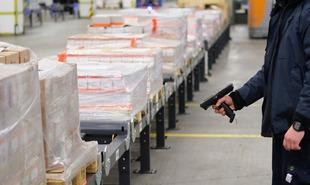 Buffer zone near Dresselhaus
When collaborating with wrapping and conveyor technology, the transfer points for goods vary. For example, many customers have their goods picked up by a narrow-aisle forklift and stored in a high-bay warehouse. Alternatively, a mobile robot transports the goods to a freight elevator, where they are moved to a different floor. Other applications in the shipping area act as an interface to a wrapping machine, which automatically wraps and secures the goods on the pallet for onward transport.
Beyond the integrated lifting height
The vehicles transfer the goods to the customer's conveyor system or various storage areas. If required, the mobile robots are equipped with static or moving special attachments, such as height adapters, which allow them to lift pallets above their integrated lifting height. This is sometimes necessary with the customer's existing systems. This enables the goods to be stored or transferred to the conveyor system without any problems, even if a standard vehicle lacks the necessary lifting height.
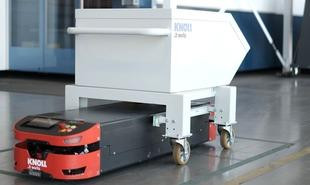 Trolley transport
The transport robots can also be used with trolleys for internal transport. These are towing vehicles, which are cheaper per unit compared to lifting models. Existing trolleys previously used for manual processes can usually be used. For this purpose, the trolleys are equipped with a snap-lock mechanism on the underside, into which the robot can move using an extendable pin.
Assembly lines
“There is currently increased demand for their use in the ‘assembly’ sector, i.e., on assembly lines,” said Stemmer. “Companies want to move away from the rigid assembly line and are relying on mobile robots that function as assembly platforms.”
Safelog implements around 100 projects per year, deploying approximately 1,000 devices. The specialists from Markt Schwaben now have over 5,000 mobile robots in operation.
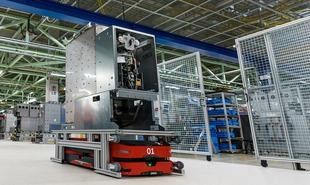 In the assembly area at ABB
On the assembly lines, mobile robots are replacing the traditional, linked assembly line and move flexibly through the line. The robot can skip points or deviate from the standard path to, for example, move the workpiece to an assembly box, a testing chamber, or a paint booth. If, for instance, a defect is detected in the transported goods in the testing chamber, the product is picked up again and taken to a rework station. Virtually all customer requirements can be easily implemented here.
Away from the rigid line
Similarly, the vehicles with their superstructures can drive into a robotic cell where assembly steps are carried out. The mobile robot can remain in the cell with the workpiece during the process, or it can place it there and wait outside. Mobile robots are in particularly high demand in assembly. Stemmer: "Many companies want to finally banish their rigid assembly lines from the factory floors and replace them with mobile robots that can move to flexible workstations.".