Compressed air has traditionally been used primarily for fixed installations. Schmalz's vacuum grippers also mainly operate with lines that often have to run across halls and facilities. However, mobile robotics increasingly requires flexible solutions – a need that Schmalz now intends to address more effectively.
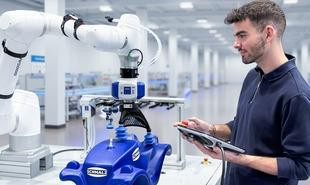
Vacuum technology grips, holds, and moves workpieces in electronics manufacturing, logistics processes, and the automotive industry. Traditionally, ejectors generate the vacuum using compressed air. This technology is well-established and continues to form the backbone of many systems. However, new production concepts require additional systems.
New requirements
Modular factories, mobile robotics, and rising energy prices are changing automation. AMRs and automated guided vehicles (AGVs) move freely through the factory. They cannot carry stationary utility connections. Collaborative robots (cobots) also follow a different principle than traditional industrial robots. They are lightweight, flexible in their deployment, and can change their workstation.

The strengths of external compressed air lie elsewhere. Michael Pojtinger, Head of Business Development Process Vacuum Automation (Components) at Schmalz in Glatten, explains Schmalz's new electric vacuum generators. They operate without a central compressed air supply; a power connection is all that's needed.
Integrated electric motor
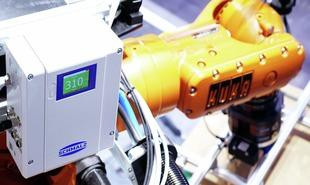
An integrated electric motor drives a pump or blower. The system generates the necessary vacuum directly at the point of use. Energy is supplied by the power grid or the robot's vehicle battery. The vacuum is created directly at the end-of-arm tooling (EOAT). This makes the gripping unit a self-contained system that operates independently of stationary connection points.
 Photos: Schmalz
This opens up new possibilities for AMR and AGV applications. The robots move through production without hose connections and do not require a fixed media supply. This approach also has an impact on cobots. Since they often operate in changing environments, every interface saved counts. Electric vacuum generators do not require external air preparation, thus simplifying integration and commissioning.
The power grid is eliminated
Electric vacuum generators produce the required negative pressure directly at the point of use and do not require a central compressed air infrastructure. "Handling remains powerful and reliable, even without the need for a piping network"Michael Pojtinger succinctly explains. Advantages are also evident in factory planning, as production cells can be easily relocated when compressed air lines do not need to be re-laid. Electricity is generally available throughout the entire facility. This reduces
planning effort and downtime during modifications.