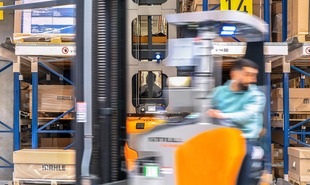
Every second vehicle worldwide is equipped with parts from automotive supplier Mahle. A current focus is on electromobility and thermal management to reduce CO2 emissions. The spare parts and service division "Aftermarket" has been modernized with a high-performance lithium-ion battery fleet from Still.
The time savings are said to be enormous, thanks to the elimination of maintenance and battery replacements, as well as faster charging processes. While this almost sounds like a cliché, it also offers significant advantages by eliminating the need to handle acids and providing a space-saving charging infrastructure that frees up valuable storage space.
 Photos: G. Knehr
In 2022, the Swabian company generated over €12 billion in revenue with approximately 72,000 employees at 152 locations and 12 research and development centers in 30 countries. The "Aftermarket" division, with over 1,900 employees, supplies workshops and wholesalers with original equipment manufacturer (OEM) quality products and service solutions. Around 80,000 products are made available worldwide as quickly as possible.
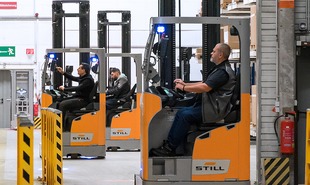
At the distribution center in Schorndorf, approximately 20,000 items await delivery in a 43,000 square meter warehouse. 1,200 pallets leave the shipping area daily, while 1,000 pallets of new products arrive at the receiving area. Seventy-six Still industrial trucks are used for the standard supply chain processes and are maintained under a full-service leasing agreement with the Hamburg-based intralogistics company.
Mirko Strobel, International Key Account Manager at Still in Stuttgart: “To maximize the availability of the forklift fleet in Schorndorf, we have equipped most of them with lithium-ion batteries.” All voltage classes are used: 24 volts for warehouse vehicles, 48 volts for electric forklifts, and 80 volts for the large narrow-aisle forklifts.
Depending on the available energy infrastructure, Still's chargers achieve a charging current of up to 375 amps, ideal especially for shorter charging times. This allows for quick and frequent top-ups during breaks – directly at the work site. Fabrizio Ruggiero, Head of Operations, explains: "Still has adapted the capacity and size of the lithium-ion batteries to our energy grid." The plant manager emphasizes that even with a low battery charge, full power is always available.
According to the company, Still's lithium-ion batteries deliver twice the energy of comparable lead-acid batteries – and always at full power. This makes them more energy-efficient and eliminates the need for complex maintenance. Furthermore, the batteries can remain in the vehicle during charging and, unlike lead-acid batteries, do not need to be replaced.
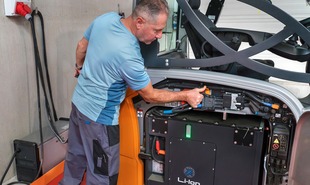
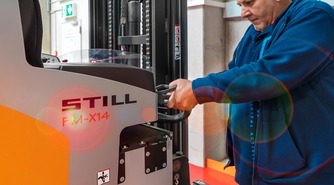
With a separate charging access point (as a customer option) on the large MX-X narrow-aisle forklifts, the battery door no longer needs to be opened for charging. Ruggiero: "By eliminating the need for exchangeable batteries, we no longer require ventilated exchange zones. The entire charging process is safer and simpler without the acids and their emissions. This has allowed us to effectively save operating costs and a significant amount of time."
Holger Betz, Regional Service Manager at Still: “We always offer batteries and chargers as pairs. This ensures that charging is never done incorrectly. The lithium-ion battery and charger form a perfectly matched system.” The lithium-ion battery communicates with the charger how the charging process should proceed. If limit values are reached or present, the charging process is either interrupted or not started at all.
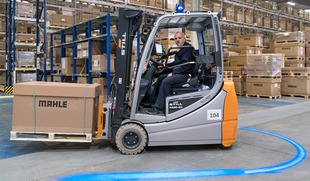
“Thanks to efficient and gentle charging processes, our lithium-ion batteries achieve up to 4,000 full charge cycles,” says Betz. Thanks to the large battery capacities, a single charge is sufficient for an entire shift. Chargers are installed decentrally and in a space-saving manner – entirely without battery swap rooms or corresponding accessories. Furthermore, the innovative
Still's lithium-ion technology enables up to 30 percent greater energy efficiency. This significantly reduces charging time and operating costs. Ruggiero: "After an intensive planning and integration phase for fire protection, I am now very satisfied with Still's new lithium-ion technology. We have already set our sights on further projects, such as modernizing our automation with industrial trucks."
Gerd Knehr