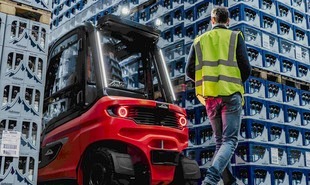
Checking the mirrors and looking over the shoulder is all well and good. Experience shows that drivers use a combined approach: On the Linde MH, a well-positioned "Reverse Assist Radar" ensures that the operator doesn't accidentally miss anything behind the vehicle.
“More than half of all accidents involving industrial trucks occur while reversing,” says Fabian Zimmermann, Product Manager for Safety Solutions at Linde MH, citing available statistics and thus drawing attention to a frequently underestimated risk. He cites the limited rear visibility of drivers as one of the main reasons. “The blind spot begins at a viewing angle of more than 180 degrees. But even before that, people and objects behind the vehicle are no longer easily perceived.” Employees now receive support from the Linde Reverse Assist Radar: The sensor-based system detects both moving and stationary objects located in the path of travel behind the forklift.
A major advantage of the solution is its powerful braking performance in emergencies. If an obstacle is detected, the Reverse Assist Radar brakes the vehicle to a standstill at a rate of up to 3 m/s². The braking effect is calculated based on the lifting height, driving speed, steering angle, and distance to the obstacle, and is therefore always tailored to the specific driving and hazard situation. Varying lighting conditions do not affect the system. If the Reverse Assist Radar detects a potential collision, it intervenes automatically and overrides the driving command. "The system provides invaluable assistance, especially in hectic warehouse situations, when inexperienced forklift operators are at the controls, when materials are incorrectly placed and obstruct the driving path, or when drivers are distracted," says Zimmermann.
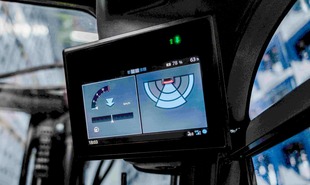 Image: Linde MH
In case of danger, the system warns the driver in several stages with an acoustic signal. If the forklift is equipped with an optional 7" display, the operator also receives a visual warning and is prompted to check the area behind the vehicle. The detection range is set to the width of the rear of the forklift by default, but can be individually adjusted. "The system only reacts to obstacles in the defined travel path," the product expert explains. Goods or other objects located to the right and left of the path, for example in a block storage area, will not trigger the system. This prevents unnecessary disruptions or interruptions.
Another product advantage is the compatibility of the Linde Reverse Assist Radar with other safety assistance solutions. "To minimize risks in the warehouse and avoid hazardous situations with industrial trucks, it can be quite useful to combine several solutions," explains Zimmermann. This includes, for example, the AI-based Front Assist Camera, which detects hazardous situations involving pedestrians when driving forward and reduces the vehicle's speed accordingly. The Reverse Assist Radar will also be available as a retrofit solution in the near future.