On September 23, will celebrate Kardex Mlog with around 400 guests in Langenbrettach-Neudeck. The history of the intralogistics specialists began in 1922 with the founding of a steel construction company – and soon took off with technological milestones.
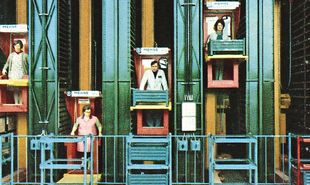
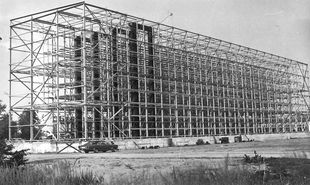
Initially focused on the construction of steel structures, bridges, tanks, buildings, and halls, the company established departments for crane construction, mechanical engineering, and conveyor technology in the 1960s. In 1966, the first order was placed for five order picking machines for the central spare parts warehouse of the Fiat plant in Heilbronn. As early as 1968, the first automated high-bay warehouse (HBW) was built in silo construction, reaching a height of 25.8 meters – a technological milestone featuring a self-developed rail- and floor-guided storage and retrieval machine (SRM). This solution operated significantly more precisely than the overhead SRMs that had been standard until then.
In the 1970s, company founder Erwin Mehne made a name for himself as a general contractor, and several more high-bay warehouses were built. In 1970, the first stacker crane for use in a deep-freeze warehouse was designed and built. In 1972, the first system with a self-developed, wired, automated control system went into operation at the pasta manufacturer Birkel. A highlight of this era was the automated high-bay warehouse with conveyor technology and order picking area, developed and manufactured in-house, completed in 1974 for the United Paper Mills in Feuchtwangen. That same year, Erwin Mehne built a high-bay warehouse in Berlin with a conveyor connection to the four-story production facility of Gillette Germany.
The 1980s were marked by the introduction of programmable logic controllers (PLCs), which Erwin Mehne first used in 1981 in a fully automated high-bay warehouse for Daimler. A year earlier, the company had already demonstrated its expertise in automated small parts storage systems. For Porsche, the company built a completely computer-controlled system featuring the legendary "Mekomat" small parts storage and retrieval system.
In 1989, the company merged with MAN Lager- und Systemtechnik, founded in 1974, and Wolffkran. As a subsidiary of MAN GHH, headquartered in Oberhausen, the company name was changed to MAN GHH Logistics GmbH. By then, 60 high-bay warehouses and 630 stacker cranes had already been built. In 1997, MAN GHH Logistics became MAN Logistics GmbH, which developed into one of the leading providers of conveyor and material flow technology components, systems, and complete solutions.
The name MLOG Logistics originated in 2005 as part of a management buyout. The opening of the northern branch in Bad Salzuflen in 2007 (later relocating to Herford) and the establishment of the Rhine-Ruhr Service Center in Oberhausen that same year laid the foundation for further expansion and customer proximity. MLOG's headquarters moved to Neuenstadt am Kocher in 2009.
 Photos: Kardex MLOG
With the acquisition of MLOG Logistics by the Kardex Group in 2010, entirely new perspectives opened up for the intralogistics pioneer. Under the umbrella of the globally operating parent company, new markets could be developed and further investments made in its home region. Internationalization also progressed rapidly, leading to the establishment of a Polish site in Sopot in 2021. Furthermore, Kardex Mlog strengthened its position as a provider of complete hardware and software systems. The proprietary warehouse management system, Kardex Control Center, was expanded with new modules and now covers all functional areas, from material flow computing to plant visualization.
Kardex Mlog also lived up to its reputation as an innovation leader on the hardware side: In 2010, the company presented the Kardex MDynamic small parts stacker crane. The Kardex MMove wireless pallet shuttle and the Kardex MSpacer load handling device were launched in 2014. With the now-patented fork for stacker cranes, the second row is also utilized to its full height in double-deep storage. This results in a space saving of over 1800 mm per aisle in a 20 m high warehouse. In 2017, Kardex Mlog built the tallest high-bay warehouse in the company's history, reaching a height of 45.3 m, for the Polish household appliance manufacturer Amica in Wronki.
Conclusion: Thanks to its unwavering commitment to innovative solutions, Kardex Mlog now offers a broad range of intralogistics systems. In addition to individually designed high-bay warehouses with stacker cranes up to a height of 45 meters, the portfolio also includes stacker trucks, conveyor modules, and turnkey, modular, and scalable system solutions manufactured in-house. Modernizing existing systems – including those from other suppliers – has established itself as an important and rapidly growing business segment. A flexible, comprehensive service, from spare parts management to 24/7 on-site support and complete technical assistance, rounds out the service portfolio. And today – after a century of development – Kardex Mlog, as a provider of integrated material flow systems and high-bay warehouses, can look back on over 1,000 completed projects.