When the lights go out somewhere ,itIn's a bad sign – especially in brick-and-mortar retail. Beumer, however, is already systematically preparing for a operation."lights-out"order fulfillment, it relies on largely autonomous robot and automation processes.
“These days, it’s expected that virtually any size and quantity of an item can be delivered on demand”says Gregor Baumeister, Head of Warehousing & Distribution Logistic Systems at the Beumer Group. This trend will continue to intensify, and automation is accelerating the transition to “dark warehouses”The latest developments in AI and data analytics are also contributing to this trend. Beumer is already thinking about what the world of warehousing and distribution will look like in ten years. The key will be systems and services that enable warehouse operators, logistics managers, and third-party logistics providers (3PLs)toachieve efficient omnichannel distribution through flexible, automated systems.
Beumer ranks the provision of end-to-end solutions for automated material flow, which also include powerful diagnostic tools, under the heading "Easy to do business with".
 Photos: Beumer
What will the inside of one of the so-called "Fashion Fulfillment Centers 2035" look like? The usual textbook answer is: Physically demanding work will be replaced by robots or automation processes so that people can concentrate on more productive or administrative tasks.
In 2035, robots on legs or wheels unload boxes from newly arrived shipping containers at the receiving area. These robots place the boxes onto conveyor belts that feed a high-speed sorting system. From there, the boxes are either transferred to palletizing robots for reserve storage or handed directly to the Goods-to-Person (GTP) system for storage and order picking. Even complex handling tasks, previously reserved for humans in GTP applications, can now be performed safely and reliably by autonomous devices thanks to AI: By 2035, this will no longer pose a problem due to the rapid advancements in computing power for digital analytics, the speed of cloud-based applications, and progress in image processing, AI, and grippers.
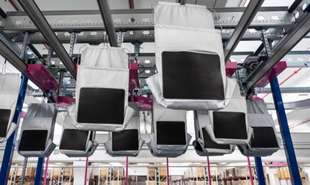
The autonomous robots now handle the core of the order fulfillment process: a modularly scalable BG Pouch system capable of handling up to 10,000 items per hour per module. It can process not only flat-packed garments from the GTP system but also garments on hangers (GoH). This allows several process steps to be combined into a single, streamlined workflow. The system is also able to efficiently process returns, bypassing all warehousing and picking operations and thus minimizing the time to resale.
At the packing station, items are automatically unloaded into the packaging system using sustainable and resource-optimized materials. The system is equipped with a variety of freely programmable sorting options. These allow for optimal control of warehouse or shelf replenishment, as well as easy coordination of shipping sequences.
BG Pouch System
The finished, packaged goods are then transported via a cross-belt sorter to sorting destinations, where automated guided vehicles (AGVs) pick up the shipping containers for e-commerce orders and load them into the vehicles of the contracted courier, express, and parcel services. For deliveries to retailers, the boxes or containers are taken directly to collection points where autonomous robots load trailers or containers.
Gregor Baumeister: “We are already close to implementing the dark warehouse. Robotics and sorting technologies are already available. Advances in software and diagnostics already make it possible to monitor and optimize warehouse operations more efficiently. Soon, working in physically demanding warehouse and distribution areas will also be a thing of the past. Perhaps we won't even have to wait until 2035…”