The food retailer Axfood and Witron have built an omnichannel distribution center in Bålsta, Sweden , from which more than 1500 branches, thousands of end customers via Click + Collect and home delivery are served with over 22,000 dry, fresh and frozen items.
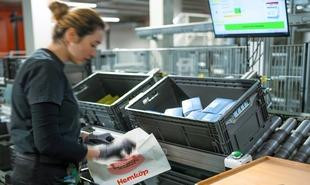 In the dry food section
In Bålsta, Sweden, about 40 km northwest of Stockholm, stands one of the most innovative logistics centers in the retail world. The highly automated facility is designed for a daily pickingcapacity of 1.6 million pick units. "Together with Witron, we have realized a facility that sets standards in the logistics world due to its efficiency, quality, and cost-effectiveness – and was commissioned on schedule despite additional challenges such as the Covid pandemic and the war in Ukraine," explains Raymond Lundmark. "All employees involved in the project can be very proud"adds the Head of Logistics at Dagab, the purchasing and logistics company of Axfood.
Ambitious project
WhenWitron project manager Holger Weiss talks about "his" Axfood logistics center in Bålsta, one quickly gets an impression of the scale of the successfully implemented project. "We have never experienced such an interplay of systems, of IT and mechanics, on such a scale and with such intensity. We are experiencing omnichannel logistics 'at its best,' and in terms of business process integration, it is the most demanding project in Witron's history to date," Weiss reports proudly.
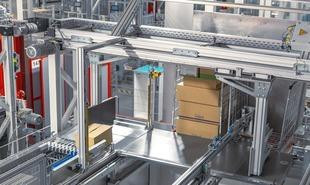 OPM picking in the telecommunications sector
The figures are impressive: 103,000 square meters of logistics space, over 22,000 different products – dry goods, fresh produce, and frozen goods. Frozen pizza, fruit, vegetables, convenience foods, sausages, meat, bread, cheese, and pasta, as well as cosmetics and toys, are stored within a temperature range of -26°C to +18°C. More than 1.6 million picked units leave the logistics center every day. Over 1,500 stores and several thousand e-commerce/click+collect customers are supplied from the logistics center near Stockholm.
Integrated system
Three years ago, Nicholas Pettersson, then president of Dagab, traveled the world, reviewed numerous reference solutions, and ultimately commissioned the Upper Palatinate-based company. Axfood is the second-largest in recent years business development, had repeatedly faced capacity problems in its logistics sector
primarily manual, warehouses were constantly operating at full capacity," explains Lundmark, and the Swedish company wanted to position itself for long-term sustainability. Securing growth and their own high standards for quality logistics and customer service across all sales channels were also key factors. Omnichannel was the magic word.
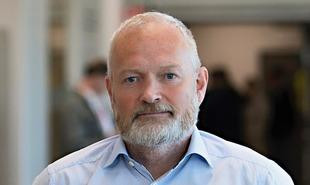 R. Lundmark
The online store accesses the same inventory as the brick-and-mortar stores. Processes that separate handling and subsequent complex consolidation in conventional warehouse logistics are managed by the system in a single, integrated warehouse logistics system. This not only significantly increases the efficiency, performance, and quality of picking and packing processes but also enables substantial investment savings. Known at Witron as OCM (Online Warehouse Management).
tightly integrated module mix
“OCM stands for the integration of all horizontal and vertical players in an omnichannel network: suppliers, logistics centers, transport, as well as the various sales channels – branch, doorstep, click + collect, drive-throughs,” explains Witron CEO Helmut Prieschenk. The goal is to create a platform, a high-performance end-to-end retail logistics network, in which all nodes communicate constantly and optimize each other. “Crucially, this project wasn’t just an automation or supply chain project, but a company-wide transformation project.”
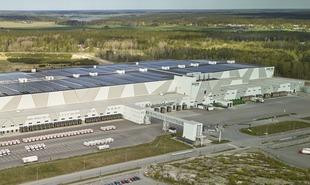 The new logistics center
Witron installed a modular system there that works together seamlessly: the OPM for traditional branch deliveries, the CPS for large and bulky goods, and the AIO for small parts storage. In addition, a fully automated outbound buffer optimizes the entire shipping process for the branch operations on a just-in-time basis . The order picking for e-commerce orders was also elegantly solved. Here, the containers are automatically sorted and stacked by a so-called Route Sequence Buffer immediately after picking, allowing a shipping employee to load them into the respective delivery vehicle according to the route and sequence.
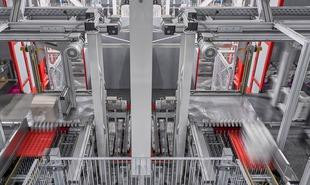 OPM picking
Depending on the sales channel, deliveries are made using a variety of different load carriers: store-ready pallets and roll containers, refrigerated containers, bins, specially designed freezer-compatible delivery boxes, and environmentally friendly paper bags. Innovative algorithms ensure that for every store or online order, products from different temperature zones are efficiently combined and, furthermore, that they are packed in a space-saving manner onto or into the optimal shipping medium.
New freezer containers
over 700,000 storage locations for wooden and plastic pallets, roll containers, bins, and refrigerated The new logistics center boasts of conveyor technology, all controlled by a multifunctional warehouse management system with open interfaces from the WMS to the customer's supplier systems, route planning systems, and sales systems. A Witron on-site service team of approximately 200 employees ensures consistently high availability of all components and processes around the clock, 365 days a year, through multi-shift operation .
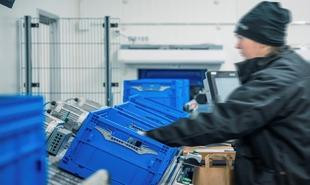 Containers in the frozen food area
A particular challenge was the many different load carriers – especially in the frozen food sector. "We also developed a new load carrier on the side," Lundmark laughs. Instead of using dry ice to cool frozen goods in e-commerce orders, as is usually the case , they developed a completely new container system together with Witron – specially insulated
containers and frozen lids serve as cooling elements. These lids are pre-chilled in the warehouse (for two to three days in special freezer zones) and then automatically placed on the containers. After delivery, the lids and containers are returned, refrozen, and reused. "Many e-commerce companies avoid frozen goods because they don't know how to solve the problem. Now we have a very efficient solution, also from an economic perspective," Lundmark explains.
Dry ice is a thing of the past.
If an e-commerce customer orders frozen peas, chocolate, and shower gel simultaneously, the order is consolidated in special route-sequence buffers. There, the containers are automatically sorted and stacked immediately after picking, before the goods are delivered to the end customer. The process is as follows: online order → distribution by temperature zone → picking (the appropriate part of the order is picked separately in each temperature zone ) → consolidation in the route buffer → automatic sorting by delivery route → loading → delivery.
 H. Weiss
Raymond Lundmark and Holger Weiss will be fine-tuning the material flow over the next few weeks. "No one has ever implemented a project of this scale and with this functionality before us, and there are few comparable projects worldwide," Lundmark is certain. "This only works if you really work closely together as a team, think in terms of solutions, and overcome challenges together," the Swede adds.
www.witron.de