This year's general assembly of the Swiss Association for Temperature-Controlled Logistics (SVTL), held at Lenzburg Castle in early May, covered a wide range of topics, from the "homegrown" shortage of skilled workers in some places to modern employee recruitment through social media and humanoid robotics.
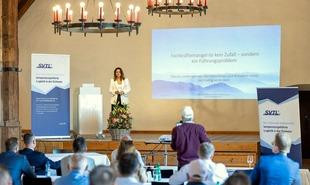 Photo: M. Nobel
In a historical setting, the 55 participants were rightly allowed to feel a little "chivalrous" but also to grapple with sometimes difficult topics ranging from "toxic management" to "dark triads" that look as if they came from Darth Vader himself in "Star Wars": "triads" of negative behaviors that make work difficult in some executive suites.

Despite this, the association, which is itself on solid footing, currently even has room to expand into areas related to continuing education by 2027. Guest speakers who addressed topics such as "Human Resources," modern approaches to personnelmanagement, and the recruitment of young talent as well as managers, well-received in the Knights' Hall. This included the question of whether increasing automation and robotization, even extending to humanoid assistants in logistics, truly makes sense.
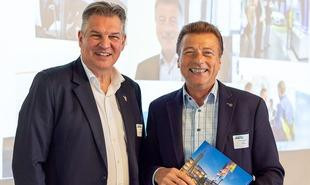 Chr. Pauli, M. Manzetti. Photo: M.Nobel
In front of 55 attendees, Marco Manzetti, whose 30-year presidency was celebrated with a small gift, and Managing Director Christian Pauli had the opportunity to recap an eventful 2025. Given the stable financial situation, Pauli even had a balance sheet in verse ready for the participants.
Successful financial year
With six-figure operating expenses, even a small profit, and a host of interesting events, the association is firmly established in the industry. Technically, they are "always a step ahead," according to Manzetti. Soon, they plan to add further value for their members by offering a support and training program, starting with a two-day seminar in 2027.
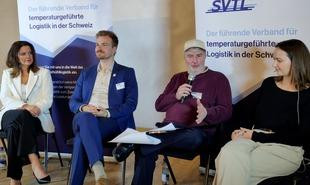 Panel discussion with P. Herzog, M. Wehner, K. Koch, M. Hausamman (from left). Photo: M. Frutig / INOVERIS
Storage space in the fresh and frozen food sections is currently at full capacity. Inquiries are also coming in from abroad, for example from Austria. Pauli: "We always forward these to our members." But at the moment, especially in the frozen food section, "there is almost no space left to be found."
Almost no space left
As in the entire industry, the shortage of skilled workers is currently impacting the temperature-controlled segment, including at the management level. Patricia Herzog, a human resources consultant and author, contributed the thesis that approximately 70% of employeeengagement in companies of all kinds depends on the respective "bosses." "People don't stay with a company for the money, but rather when they also feel emotionally supported," Herzog stated.
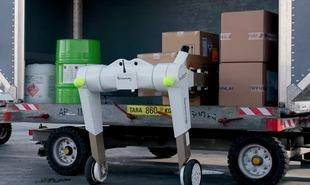 Colleague Robot. Photo: IML
The “soft factor” also, somewhat pointedly, leads to the reasons why people “run away” from some companies despite strenuous searches: narcissism, power ambitions and a certain degree of psychopathy (Herzog: “of course below the clinical level…”) are responsible, to varying degrees, for the fact that it is “simply unbearable” in some companies.
The right channels
Narcissism, Machiavellianism, and psychopathy sometimes coalesced into a "dark triad." These through employee reviews, a little experience, and empathy however, could be resolved individual "would have simply preferred to be a florist (the main thing being gender-neutral)," but in the background lay the desire for some kind of "career."
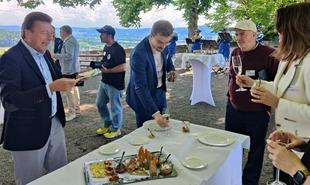 Photo: M. Frutig / INOVERIS
in the form of "social media" modern opportunities for young trainees to promote logistics allowing the young trainees themselves to contribute posts, in order to promote a "cool career image" to their peers.
Given the numerous possibilities of humans "in themselves" sometimes being on the "wrong track", it might even be reasonable to think that this could offer new potential for AI-controlled robots that could be expected to perform physically demanding work without question.
Much still to do
Manuel Wehner from the Fraunhofer Institute for Material Flow and Logistics IML in Dortmund presented an air freight scenario, separate from existing storage technology such as "AutoStore", in which Segway-like robots with gripper arms perform valuable work at the airport loading aircraft.
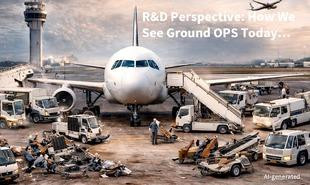 Photo: IML (AI-generated)
“But the devices don’t necessarily have to look like a human, a dog, or an ant to do their job.” He particularly likes to show a photo that—with a little AI enhancement—is supposed to document the countless instances of damage to demolished jets caused by automated vehicles during loading operations on the apron, amounting to approximately €1.6 billion annually in Europe alone, even before such widespread robotization.
Difficult to handle
And anyone who has ever opened an air freight container from Southeast Asia knows the flood of items that spill out the moment the container is unlocked – from Styrofoam and wood to insulation material and plastics. This is difficult to handle and control. Wehner: "We still have a lot of research to do in this area!".
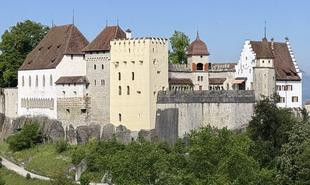 Photo:klk.
SVTL President Marco Manzetti points out that "automation in logistics" has been around for a long time. However, new approaches must also work together effectively within the overall context. Serge Frech, Managing Director of the training association Swiss Logistics by ASFL SVBL, does not believe that young people could lose their enjoyment of, interest in, or even their jobs in logistics to humanoid robots.
Technology is not a replacement
Humans are adaptable, and society depends on well-functioning logistics. For the training association, it is important that learners not only acquire knowledge and skills, but also develop practical competence and the ability to use the technology.
Serge Frech: "Technology should not be a replacement, but an aid for humans.".