Numerous awards have been bestowed upon Michael ten Hompel over the years as CEO of Fraunhofer IML. The Fraunhofer Medal, awarded at the end of May, was therefore almost overdue. It is thanks to him that logistics has found its place among the scientific disciplines.
As previously reported, ten Hompel officially retired at the end of March. At a rather private event, the "logistics pope" and father of the "Silicon Economy" was presented with a medal by Elisabeth Ewen, a member of the board of the Fraunhofer Society, Europe's largest organization for applied research. His contributions to the Fraunhofer Enterprise Labs, the Silicon Economy, and the Open Logistics Foundation are countless.
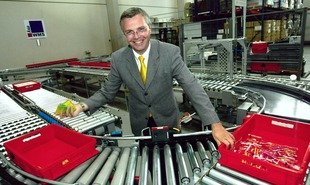 In my younger years
Over the past decades, Michael ten Hompel has been one of the most influential driving forces, if not the leading figure, in the logistics industry. From the Internet of Things and shuttle technology to smart devices and robot swarms, he has propelled technological advancements and taken them to a new level with visionary ideas such as the Digital Continuum, the Social Networked Industry, and his AI research.
Employees, development partners and renowned scientific colleagues say that he succeeded like no other in successfully linking science and practice while simultaneously putting logistics research on the agenda of business and politics.
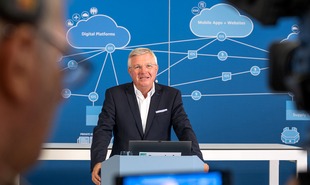
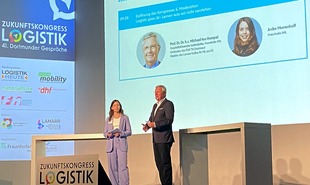 At the Future Congress. Photo: klk.
Ten Hompel is considered one of the inventors of shuttle technology in intralogistics, for which the institute received the prestigious VDI Innovation Award for Logistics in 2004. This innovation culminated in the development of new generations of autonomous vehicles (evoBOT, LoadRunner, et al.). He is also regarded as one of the fathers of the Internet of Things (IoT). Here, he tirelessly promoted the vision of self-controlling and mutually communicating "things," as well as swarm technology, and successively expanded it with building blocks for implementation. These include smart devices and social machines, which, in the "Social Networked Industry" proclaimed by ten Hompel, enable collaborative and trusting cooperation between humans and artificial intelligence.
His interdisciplinary approach created a logistics hub that is second to none. For more than 20 years, ten Hompel was a leading figure not only at the Fraunhofer IML, but also held the Chair of Materials Handling and Warehousing at TU Dortmund University. His appointment as Director of the Lamarr Institute for Machine Learning and Artificial Intelligence, which began in 2022 and will continue until the end of this year, has garnered considerable attention.
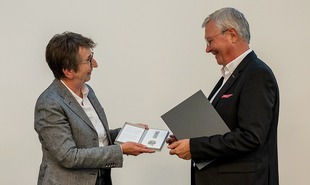 The Fraunhofer Medal...
In the past, he made a significant contribution to the further development and innovative strength of Dortmund as a center of science and technology. As a bridge-builder between science, business, and society, he played a key role in the dialogue and structural development of the European logistics landscape.
In 2019, he was appointed to the Innovation Commission of the Federal Ministry of Transport and Digital Infrastructure (BMVI). A particular highlight of his political career was the Federal Government's Digital Summit in the same year, when ten Hompel presented his vision of the "Silicon Economy," the open platform economy for Germany and Europe, to the entire Federal Cabinet, led by Chancellor Angela Merkel.
The “Silicon Economy” was one of numerous large-scale research projects that ten Hompel brought to Dortmund. It will continue to receive over €20 million in funding from the Federal Ministry for Digital and Economic Affairs (BMDV) until the end of 2024. However, the largest project of his career was the BMBF-funded Leading-Edge Cluster “Efficiency Cluster LogisticsRuhr,” launched ten years earlier. With over €100 million in funding, it remains the largest research project in logistics to this day.
The cluster significantly advanced logistics research in Germany. The project ultimately led to Logistics 4.0 and the development of logistics as a technology sector. At that time, ten Hompel also became the first representative of logistics science in the German Academy of Science and Engineering (acatech).
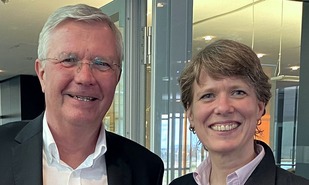 With successor A. Kirchheim. Photo: klk.
Other major research projects and initiatives in which ten Hompel participated included the founding of the Fraunhofer Academy in 2007, where he served as chairman and director until 2017; the establishment of the Lamarr Institute for Machine Learning and Artificial Intelligence, where he remains director; and the International Data Spaces (formerly Industrial Data Space), which he launched about ten years ago together with his colleagues Boris Otto and Stefan Wrobel. During this period (2014 to 2018), ten Hompel was also appointed to the management board of the Fraunhofer Institute for Software and Systems Engineering ISST, thus securing the independence of the institute in Dortmund, which is now very successfully led by Boris Otto.
In 2021, ten Hompel, as chairman of the board of trustees, launched the Open Logistics Foundation, a technologically pioneering foundation of leading, internationally active logistics companies, combining computer science and logistics. The foundation promotes the collaborative development of open-source logistics software and hardware.
The "Fraunhofer Enterprise Labs" format originated in 2013 at Fraunhofer IML as a new form of collaboration between companies, research institutions, and development organizations. Companies and Fraunhofer IML agree to a minimum three-year cooperation in agile teams with flexible research priorities. Since 2016, the newly constructed "Enterprise Lab Center" at Fraunhofer IML, initiated by ten Hompel, has also been available to these mixed teams. There, prototypes can be developed and manufactured in small series directly on-site. Last year, the format celebrated winning the prestigious German Logistics Award, in which Fraunhofer IML and its lab partner Dachser were recognized for the "@ILO" solution developed in their joint Enterprise Lab.
Michael ten Hompel has been a member of the international Logistics Hall of Fame since 2012. In 2017, he received an honorary doctorate from the University of Miskolc in Hungary, in 2018 the Gold Badge of Honor from the German Logistics Association (BVL) (he was a member of the BVL board from 2006 to 2018), and in 2019 the Hermes International Logistics Award. He was also named "Citizen of the Ruhr Area 2018," an award given to individuals who have made outstanding contributions to the Ruhr region. In 2020, ten Hompel received the Innovation Prize of the State of North Rhine-Westphalia in the "Honorary Award" category for his exceptional contributions to sustainable change in science, business, and society. In 2023, the Federal President of Germany awarded ten Hompel the Federal Cross of Merit for his outstanding commitment to science. Most recently, in February 2024, he received the Dortmund Dialogue Prize for his outstanding contribution to the structural change and innovative strength of the city of Dortmund.
Michael ten Hompel continues to advise the institute. Prof. Dr.-Ing. Alice Kirchheim succeeded him on April 1, 2024.