

WAGNER Switzerland AG




Hupac aims to shift more freight back to rail by increasing the use of the left bank of the Rhine corridor and digitally transforming the intermodal transport chain. The company has now closed its 2025 financial year with a profit of CHF 3.5 million, and transport volume increased by 4.3 percent.

In 2007, the German women's national football team won the World Cup and Apple presented its first iPhone. For KWM Weisshaar, the year was also marked by the construction of a new multi-story production hall equipped with Kasto's Unigrip buffer storage system. A retrofit was now underway, which was implemented smoothly.

Not a "lighthouse" in the true sense, but a construction project that has a signal effect in its dimensions, architectural design as well as its future function, is now being created with the groundbreaking ceremony for the doubling of the office capacity of TGW Logistics for around 50 million euros at the main site in Marchtrenk.

Prominent speakers from across the world of logistics, business, science, and technology will converge on June 18th at the GS1 Switzerland Excellence Day at StageOne in Zurich-Oerlikon . The focus will be on data-driven intelligence and sustainable supply chains.

Directly opposite its European headquarters, Clark is celebrating the expansion of its direct sales operations in Duisburg with the official opening of its premises in the Asterlagen business park. The "Western Branch" is intended to serve as an "exclusive interface" to drive market potential in the region.

The StaplerCup season is starting again at Linde Material Handling in Germany. Experienced forkliftoperators and enthusiastic newcomers can now register to qualify at over 20 venues both in Germany and abroad. The final will be held in Aschaffenburg in October.

“The USA is no longer an experiment; it is our next major revenue driver”says Kemaro, the Eschlikon-based manufacturer of cleaning robots. The company has already sold over 1,500 robots to more than 600 industrial customers worldwide. With $5 million in fresh capital, it now aims to enter the next phase of its expansion.

The general assembly of the Swiss Association for Temperature-Controlled Logistics will take place on May 8th Castle and Lenzburg , in addition to the usual agenda items, personnel management, modern advertising for skilled workers on social media and the question of whether humanoid robots will one day be helpful .

The days of unlimited supply chains are over. Global just-in-time supply chains are now on new leadershipThe 20th Logistics Day of the Kühne Logistics University (KLU) in Hamburg focused

"Fifty Shades of Grey" is a moderately boring movie about teen fantasies concerning first sexual experiences with the opposite sex. "Grey Orange" be more exciting for some: a global provider of AI-powered software for warehouse control and inventory management, whose "GreyMatter"software Dematic now wants to profit from.
Hupac aims to shift more freight back to rail by increasing the use of the left bank of the Rhine corridor and digitally transforming the intermodal transport chain. The company has now closed its 2025 financial year with a profit of CHF 3.5 million, and transport volume increased by 4.3 percent.
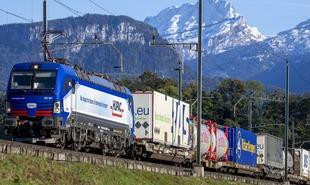 Photos: Hupac
The core business of transalpine transport through Switzerland saw growth of 4.5 percent, according to the report. This was also thanks to the acquisition of services on the Belgium-Italy axis. Nevertheless, the state of the rail infrastructure continues to hamper the development of combined transport. Stabilizing measures are urgently needed to provide market participants with a reliable future outlook. As announced, Michail Stahlhut will step down as CEO of the group. He plans to leave the company in May.
Nearly 1 million truck journeys shifted
Last year, the Hupac Group transported approximately 975,000 road shipments, or 1,853,000 TEU, in combined road/rail transport and maritime hinterland transport. Hupac increased its volume of transalpine traffic through Switzerland to around 560,000 shipments. Transalpine traffic via France and Austria increased by 26.9% to approximately 25,000 shipments, albeit from a low base. In non-transalpine traffic, Hupac increased volumes by 2.9% to nearly 390,000 shipments.
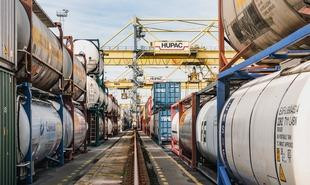
This development, given the ongoing construction work on the rail network – initially not specified in detail in the annual report without blaming neighboring countries like Germany – can be viewed positively. Extensive construction activity, with occasional complete line closures, has significantly impacted the performance of the rail infrastructure. Nevertheless, Hupac was able to increase its revenue in 2025 by 3.1% year-on-year to CHF 646 million. Revenue fell short of volume growth, which is attributed to the negative effects of exchange rates.
Stronger cost increase
Costs for services rendered rose more sharply than revenues, leading to a slight decrease in the gross profit margin of 0.6% to 21.6%. Thanks to measures to safeguard earnings, Hupac was able to maintain the group result in a challenging environment with an EBIT margin of 1.9% and a profit of CHF 3.5 million (previous year CHF 9.4 million) aatbarely satisfactory level–just .
 Going these days: M. Stahlhut
With its RadicalShift2Rail concept, Hupac is responding to the increasing delays on the rail network caused by construction work. Traffic flows are concentrated at a few high-capacity terminals and transported between them by high-frequency shuttle trains with four to six departures per day in each direction. The first connections, Cologne North-Busto Arsizio and Ludwigshafen-Busto Arsizio, were launched with the timetable change at the end of 2025. Weekly frequencies are currently 25 to 30 train pairs and could be increased further if needed. After one quarter, positive developments in punctuality and resilience were observed. Further high-frequency services are planned to be added with the timetable change at the end of 2026.
Improved planning certainty
This innovative approach has led to a stabilization of combined transport and improved planning certainty. It requires strategic cooperation with railway undertakings, for example, to effectively represent their shared interests to infrastructure operators. Major construction projects and diverted traffic must be optimized across national and company boundaries within the framework of joint multi-year planning to ensure that the planned transport volumes can be handled reliably.
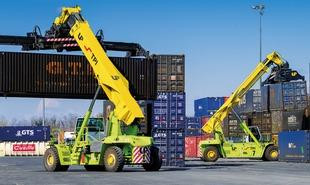
At the beginning of 2026, the Shuttle Net Business Unit gained further market share (+50% Basel-Busto Arsizio) thanks to the new Duisburg-Novara product and the strengthening of the Basel-Busto Arsizio connection. Both products successfully shifted some of the traffic previously handled by the "Rolling Highway" , to unaccompanied combined transport, thus maintaining volume on the rail network.
Market leader in Europe
Hupac continues to focus on developing combined transport in Alpine transit through Switzerland. The company aims to make a significant contribution to achieving modal shift targets together with its customers. With approximately 560,000 road shipments, or 11 million net tons, Hupac achieved an increase of around 24,000 shipments in 2025, thus consolidating its position as market leader on the most important combined transport corridor in Europe.
After three decades of successful shift from road to combined transport, the trend actually reversed four years ago. Since 2022, the volume of transalpine combined transport has decreased by 11%, while road transport has increased by 4% over the same period. With the discontinuation of the "Rolling Highway" at the end of 2025, this trend is expected to continue.
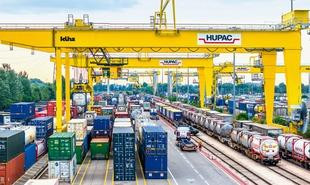
Hupac sees the main cause of this negative trend in the renewal of the rail infrastructure. Even in 2025, the issue of construction sites was central to European rail freight transport. Larger construction projects are planned for the north-south corridor in the next two years. "Without countermeasures," they state, "further setbacks are threatened with a key transport policy objective for Switzerland."
Avoid further setbacks
Hupac aims to reverse the negative trend of modal shift through innovative transport concepts and by deepening its partnerships with railway companies and infrastructure operators. This should make it possible to keep quality deficits within limits over the next two years. "The major construction projects on the Rhine-Alpine Corridor will be completed by 2029," Hupac stated. From then on, they anticipate new growth opportunities.
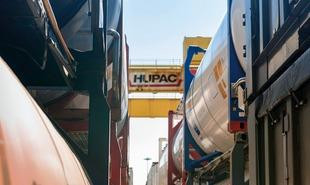
The Federal Council's decision in spring 2026 to extend operating subsidies for transalpine combined transport beyond 2030 creates planning certainty and helps all stakeholders in the intermodal chain make the necessary investments to get combined transport back on track. Hupac is confident that it will return to a growth trajectory from 2029 onwards, once the major construction work on the German Rhine Valley axis and in northern Italy is completed.
Unlocking new potential
Hupac itself is investing in new, high-performance terminal infrastructure with Piacenza (commissioning in 2025) and Milano Smistamento (planned opening in 2027). In addition, Hupac is expanding its network westward. To this end, the Barcelona Combiconnect terminal was commissioned in early 2026, improving the Iberian Peninsula's connection to the European intermodal network. Hupac sees considerable potential for combined transport in the transport market to and from Spain, which is currently dominated by road transport.
Given the current geopolitical situation, the risk of a significant global economic slowdown is very real. Against this backdrop, Hupac is cautious regarding its short-term growth potential. The company's management anticipates that the framework conditions for combined transport will remain challenging over the next two years.