
WAGNER Switzerland AG




Many participants of the test camp also took the opportunity to attend the 33rd Material Flow Congress – held for the first time in Dortmund – under the direction of Professor Johannes Fottner. A total of around 800 visitors came to Dortmund's Westfalenhalle to view approximately 100 innovations.

The shift to rail freight through the Alps has suffered significant setbacks recently. According to BLS Cargo, the main culprits are the dilapidated German infrastructure and the numerous line closures and construction sites along the north-south corridor. This is also impacting personnel policies.

Kion will be the first company in Europe to use Siemens' new simulation software " Digital Twin Composer " , thereby also seeking a degree of independence from the US market, where NVIDIA has so far been the dominant solution for merging the digital and real worlds in smart warehouses.

Now Linde MH also offers an expanded series with an integrated lithium-ion battery: The major advantage, according to the manufacturer, is the increased space in the driver's cab, which is up to 35 percent above the industry average, and the fact that the footwell has grown significantly with the elimination of the traditional battery compartment.

As part of the Test Camp Intralogistics and the International Intralogistics and Forklift of the Year (IFOY) Award, the preliminary certificates for 2026 were presented in Dortmund by Jan Drömer, Chairman of the VDMA Materials Handling and Intralogistics Section, to the 17 nominees who will now go into the final round.

The general assembly of the Swiss Association for Temperature-Controlled Logistics will take place on May 8th Lenzburg Castle and , in addition to the usual agenda items, personnel management, modern advertising for skilled workers on social media and the question of whether humanoid robots will one day be helpful .

German technology remains highly regarded when it comes to rapid material handling, the elimination of weaknesses, and service quality. Following successful projects in Oklahoma and Texas, the steel trader " Steel and Pipe Supply " (SPS) in Kansas City once again relied on Kasto saws and storage systems.

Bito is launching an offensive with an economical alternative for companies that want to re-equip, expand, or temporarily supplement their warehouse and production areas, but don't want to tie up their capital long-term: renting instead of buying is the motto. The advantages – especially in " dynamic times " – are obvious.

Logistics provider Yusen is presenting an expanded global platform for the healthcare sector at LogiPharma in Vienna, where companies such as Novartis, Bayer, Takeda, and hospital supplier UCB are currently participating. The platform focuses on the professional delivery of specialized healthcare solutions.

Coop's own rail connection for urban logistics in Zurich, streamlined logistics vehicles and the outsourcing of all operating room logistics in a cooperation between the Seeschau Clinic and the Swiss Post are the projects that are entering the final sprint for this year's Swiss Logistics Award from GS1.
The shift to rail freight through the Alps has suffered significant setbacks recently. According to BLS Cargo, the main culprits are the dilapidated German infrastructure and the numerous line closures and construction sites along the north-south corridor. This is also impacting personnel policies.
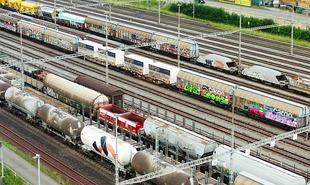 Photo: SBB
Switzerland, according to the company founded in Bern in 2001 with around 400 employees and 150 locomotives, has done a great deal in the past 25 years to promote the shift to rail transport. However, Swiss modal shift policy is now at a turning point. It is high time for new political impetus.
Relocation policy under pressure
The Swiss Transport Workers' Union (SEV) is also warning against further delays in the shift of freight traffic from road to rail, given the financial results of BLS and BLS Cargo. Due to cost-cutting pressures in regional passenger transport and the downturn at BLS Cargo – partly caused by the premature discontinuation of the rolling highway service between Fribourg and Novara (RAlpin) – the BLS Group is currently reporting a loss of 10.3 million Swiss francs. After two years with group profits exceeding 20 million francs each, this is "unpleasant " as they say, but "manageable " If only.
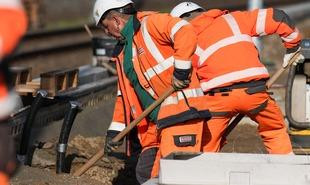 Track work in Germany. Photo: DB
The situation is serious: 15-20% of BLS Cargo trains are currently cancelled, meaning a reliable service can no longer be offered to customers. Adding to the unstable operations are rising costs for freight railways because locomotives and drivers can no longer be deployed efficiently. Despite the poor availability of infrastructure, track access charges continue to rise relentlessly in all countries, cancellation fees are being levied, and the demands on the expensive Electronic Train Management System (ERTMS) are increasing.
Demands on the DB colleague
, the control and construction site and maintenance management of the German network operator DB InfraGO play a crucial role: only when track interruptions are significantly reduced, diversions are provided, renovations are shifted to low-traffic periods and track access charges are kept constant – only then can freight railways like BLS Cargo stabilize their operations and contribute to modal shift again.
 DB CEO E. Palla. Photo: DB
Because it appears that the next two to three years will also be characterized by extremely intensive construction activity, BLS Cargo, together with the industry, is in close contact with the management of DB InfraGO. The freight industry, particularly in combined transport, recently addressed an open letter to the new CEO of Deutsche Bahn, Evelyn Palla, and the German Transport Minister, Patrick Schnieder . Dirk Stahl, President of the ERFA (Experience Exchange), co-signed the letter. The message: This situation cannot continue.
Wanted: Relocation policy 2.0
The shift of freight transport from road to rail must not decline further. If more and more transport is shifted back to the roads, not only is the transport system at risk of collapsing in certain areas, jeopardizing security of supply and the stability of logistics chains, but important sustainability goals could also be missed.
There is undeniably a modal shift crisis in freight transport – in Switzerland and throughout Europe. Policymakers are called upon to find effective solutions quickly. Only by modernizing the northern feeder lines to such an extent that reliable and stable operations are guaranteed and the structural cost disadvantage of rail freight is significantly reduced can the modal shift back to rail be stopped.
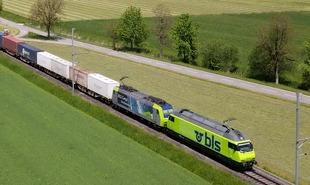 Photo: BLS
For the planned closures of the Rhine Valley Railway during peak traffic periods in the coming years minimum capacity guarantees, compensation funds, and the suspension of cancellation fees and track access charges in cases must be negotiated with the infrastructure operators and transport ministries . CO2 compensation, from which rail freight currently benefits, should be further expanded. According to the latest forecasts, Switzerland will significantly miss its 2030 climate targets . The transport sector is responsible for this – notably.
"Don't cut corners on staff"
According to the SEV union, strengthening rail freight will only succeed with highly motivated staff. Good working conditions, adequate qualifications, and high safety standards are essential prerequisites for reliable rail operations. " Attempts short-term competitive advantages over road transport through deregulation, increased pressure on staff, or lowered requirements are misguided " says Barbara Keller, Vice President of the SEV. " Anyone who is serious about shifting freight to rail must invest in the railways – and not cut corners on staff."
 B. Keller. Photo: private/courtesy of B. Keller
Together with the European Transport Workers' Federation (ETF), the SEV aims to further strengthen rail freight transport at the European level. The ETF has launched the #SaveRailFreight campaign for this purpose. It consolidates the demands of European railway unions for increased public investment and the preservation of an efficient rail freight system. The goal is to prevent further shifts to road transport.
Alternative routes are being developed
At least: By 2028, the German Stuttgart–Singen line and its Swiss extension Schaffhausen–Oerlikon–Othmarsingen are to be upgraded to relieve the German Rhine Valley line and serve as an alternative route. Following a declaration of intent this year, work has begun with France to develop the left bank of the Rhine line into a modern and efficient feeder line for freight traffic. On the Swiss side, two tunnels near Basel will be upgraded for this purpose; the main construction work is scheduled to begin in 2026.