WAGNER Switzerland AG




German technology remains highly regarded when it comes to rapid material handling, the elimination of weaknesses, and service quality. Following successful projects in Oklahoma and Texas, the steel trader " Steel and Pipe Supply " once again relied on saws and storage systems from the Rhine Valley in Kansas City.

Bito is launching an offensive with an economical alternative for companies that want to re-equip, expand, or temporarily supplement their warehouse and production areas, but don't want to tie up their capital long-term: renting instead of buying is the motto. The advantages – especially in " dynamic times " – are obvious.

Logistics provider Yusen is presenting an expanded global platform for the healthcare sector at LogiPharma in Vienna, where companies such as Novartis, Bayer, Takeda, and hospital supplier UCB are currently participating. The platform focuses on the professional delivery of specialized healthcare solutions.

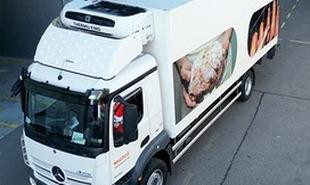
Coop's own rail connection for urban logistics in Zurich, streamlined logistics vehicles and the outsourcing of all operating room logistics in a cooperation between the Seeschau Clinic and the Swiss Post are the projects that are entering the final sprint for this year's Swiss Logistics Award from GS1.

Compressed air has traditionally been used primarily for fixed installations. Schmalz's vacuum grippers also mainly operate with lines that often have to run across halls and facilities. However, mobile robotics increasingly requires flexible solutions – a need that Schmalz now intends to address more effectively.

Safelog, the specialists for software for controlling intralogistics processes, have entered into a cooperation with the drive experts from SEW Eurodrive at LogiMAT in order to jointly develop a high-performance software for controlling mobile and stationary processes in intralogistics.

“Never walk alone” could be the motto of a networking event hosted by the consulting experts from “Adnovum”, where the Digital Product Passport (DPP), cybersecurity and IT opportunities with Petra Merino (GS1 Switzerland) and security expert Andreas Achterholt are on the agenda on May 7th in Zurich.

With a new workshop in Obersiebenbrunn near Vienna, rail manufacturer Stadler is expanding its capacity for the commissioning, approval, and servicing of modern rail vehicles in Austria. The workshop has been used to maintain Westbahn's high-speed trains since March 2026.

Idealworks, part of the Munich-based Agile Robots Group, with more than 1,700 AMRs and AGVs worldwide and one of the pioneers in industrial automation through AI in robot-controlled logistics processes, has founded a US company headquartered in Greenville, South Carolina.

At LogiMAT, conveyor technology provider Interroll attracted attention with a new chain-belt sorting system developed after the acquisition of Sortteq. Together with MCP Play, this creates a material flow ecosystem that combines single-item transport with intelligent sorting.
Coop's own rail connection for urban logistics in Zurich, streamlined logistics vehicles and the outsourcing of all operating room logistics in a cooperation between the Seeschau Clinic and the Swiss Post are the projects that are entering the final sprint for this year's Swiss Logistics Award from GS1.
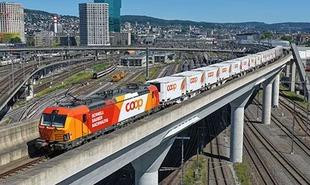 The project «City Cargo Zürich»
Coop's " City Cargo Zurich " project attracted attention for its urban logistics initiative: Retail outlets in Zurich are supplied on a large scale and systematically via their own rail company using combined transport. This shifted the majority of transport from road to rail, with the aim of reducing traffic congestion, stabilizing processes, and significantly lowering CO₂ equivalent emissions.
Rail and road combined
Since June 2025, approximately 71 retail outlets have been supplied via a combined rail and road system . The starting point is the distribution center in Schafisheim, where swap bodies are loaded with unrefrigerated, refrigerated, and frozen goods. These are then transshipped onto railcars and transported by train for approximately 42 km to Zurich.
At the newly opened Zurich hub, goods are transferred back to road vehicles for final distribution. Only the last mile to the retail outlets is thus covered by road. At the same time, empty containers and waste such as packaging material, organic waste, or PET bottles collected upon delivery and transported back to Schafisheim via the same route.
There, at the empty container center, the containers are collected and handed over to recycling companies. Three trains carrying a total of approximately 32 swap bodies run daily between Schafisheim and Zurich. By shifting a large portion of the transport to rail, roughly 58,000 truck journeys can be saved. This results in a reduction of CO₂e emissions of around 80 percent compared to road transport alone. The project is based on combining existing logistics processes with new technical solutions. These include specially equipped vehicles for the rapid handling of the swap bodies and the developed "rCE-Powerpack," which generates energy for refrigeration units during the train journey.
Nursing staff relieved
Many hospitals face a paradox: highly qualified nursing staff spend a significant portion of their working time on non-nursing logistical tasks. Ordering, warehousing, order picking , and material documentation consume valuable time that is then lacking at the patient's bedside. High inventory levels tie up space and capital, while the manual processes limit the hospital's scalability.
The Seeschau Clinic has found the answer to this challenge in a radical process innovation in partnership with Swiss Post. The clinic is outsourcing its entire surgical logistics – from purchasing surgical supplies and warehousing to delivery.
 Operating room logistics outsourced
The core element is case-specific just-in-time delivery: For each planned procedure, individually assembled case boxes containing consumables are provided. At the operating room entrance, a single scan is all it takes to digitally record all items. Unused materials are returned, automatically recorded, and restocked. The entire process chain – from ordering and delivery to invoicing – is digitally documented , eliminating any breaks in the workflow.
The new system significantly reduces the workload for specialists. Previously, operating room staff spent up to 30 percent of their working time on non-surgical tasks. This time can now be dedicated to patient care. At the same time, storage space is freed up, allowing for the creation of additional operating room capacity without any structural alterations.
A special " Post Health Cockpit " will allow for real-time monitoring of inventory in the future. A genuine added value in healthcare.
Improved aerodynamics
For transport companies facing rising fuel prices and increasing pressure for efficiency , simple, effective solutions for reducing consumption and emissions are in high demand. This naturally also applies to air resistance.
With a flow element dubbed TELP, Eiger Mechanics has developed a small, passive aerodynamic component that selectively smooths unwanted turbulence and influences the flow boundary layer. The elements can be easily mounted in a specific grid pattern on existing flow surfaces such as truck spoilers. The measure is cost-effective, straightforward, and achieves immediately measurable effects: air resistance decreases, and diesel consumption and CO₂ emissions are reduced.
 Photos: GS1 / SLA
The effectiveness of the flow element, it is said, has been proven through both computational fluid dynamics (CFD) simulations and measurements in real-world traffic. Typical savings range from 3 to 10%. For a 40-ton semi-trailer truck, this equates to approximately 1.3 liters of diesel per 100 km. Extrapolated to an annual mileage of over 100,000 km, this results in considerable savings. With fleet adjustments, transport companies can significantly reduce their operating costs, and the return on investment (ROI) is typically one to two years.
Total consumption extrapolated
The patent-pending TELP flow element operates reliably even in dynamic pressure conditions. It not only reduces the fuel consumption of conventional diesel trucks but is also suitable for new drive systems such as electric and e-fuel vehicles. Extrapolated to the entire truck fleet registered in Switzerland (including vans), annual diesel consumption could decrease by over 180 million liters, which would to more than 450,000 tons of CO₂ emissions .