
WAGNER Switzerland AG




As part of the Test Camp Intralogistics and the International Forklift of the Year (IFOY) competition, the preliminary certificates for 2026 were presented today in Dortmund by Jan Drömer, Chairman of the VDMA Materials Handling and Intralogistics Section, to the 17 nominees who will now go into the final round.

The general assembly of the Swiss Association for Temperature-Controlled Logistics at Lenzburg Castle on May 8th will address, in addition to the usual agenda items, personnel management, modern advertising for skilled workers on social media and the question of whether humanoid robots will one day be helpful .

German technology remains highly regarded when it comes to rapid material handling, the elimination of weaknesses, and service quality. Following successful projects in Oklahoma and Texas, the steel trader " Steel and Pipe Supply " (SPS) in Kansas City once again relied on Kasto saws and storage systems.

Bito is launching an offensive with an economical alternative for companies that want to re-equip, expand, or temporarily supplement their warehouse and production areas, but don't want to tie up their capital long-term: renting instead of buying is the motto. The advantages – especially in " dynamic times " – are obvious.

Logistics provider Yusen is presenting an expanded global platform for the healthcare sector at LogiPharma in Vienna, where companies such as Novartis, Bayer, Takeda, and hospital supplier UCB are currently participating. The platform focuses on the professional delivery of specialized healthcare solutions.

Coop's own rail connection for urban logistics in Zurich, streamlined logistics vehicles and the outsourcing of all operating room logistics in a cooperation between the Seeschau Clinic and the Swiss Post are the projects that are entering the final sprint for this year's Swiss Logistics Award from GS1.

Compressed air has traditionally been used primarily for fixed installations. Schmalz's vacuum grippers also mainly operate with lines that often have to run across halls and facilities. However, mobile robotics increasingly requires flexible solutions – a need that Schmalz now intends to address more effectively.

Safelog, the specialists for software for controlling intralogistics processes, have entered into a cooperation with the drive experts from SEW Eurodrive at LogiMAT in order to jointly develop a high-performance software for controlling mobile and stationary processes in intralogistics.

“Never walk alone” could be the motto of a networking event hosted by the consulting experts from “Adnovum”, where the Digital Product Passport (DPP), cybersecurity and IT opportunities with Petra Merino (GS1 Switzerland) and security expert Andreas Achterholt are on the agenda on May 7th in Zurich.

With a new workshop in Obersiebenbrunn near Vienna, rail manufacturer Stadler is expanding its capacity for the commissioning, approval, and servicing of modern rail vehicles in Austria. The workshop has been used to maintain Westbahn's high-speed trains since March 2026.
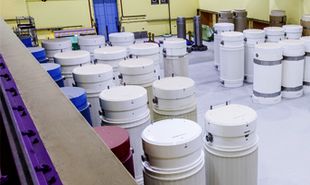 Containers in interim storage. Photo: Nagra
The region is unsettled. Just on Saturday, an earthquake measuring 4.3 on the Richter scale near Mulhouse, about 50 km away, shook the Rhine River and was clearly felt in the Black Forest. On Monday, starting at 9 a.m., NAGRA will announce in a live conference where it plans to dispose of its radioactive waste in the future.
Radioactive waste is generated in Switzerland during electricity production at the Beznau, Leibstadt, and Gösgen nuclear power plants, as well as during the decommissioning of the Mühleberg nuclear power plant, and also in medicine, industry, and research. A distinction is made between high-level waste (HLW) and low- and intermediate-level waste (ILW). By 2075, a volume of approximately 90,000 cubic meters (see table) is expected to accumulate. Around 90 percent of this is ILW, the majority of which will only be generated during the decommissioning of the nuclear power plants.
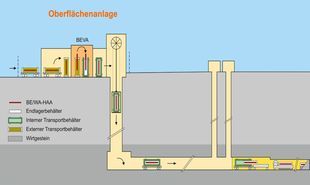 Fig.: Nagra
Depending on the waste category, this waste must be safely stored for tens of thousands to a million years until it no longer poses a threat to humans and the environment. Currently, it is stored in secure halls on the Earth's surface, located at nuclear power plants and in two central interim storage facilities in the canton of Aargau.
It is legally mandated that the waste be safely disposed of in deep geological repositories for the long term. The site selection process for this has been underway since 2008, following a sectoral plan. The final site selection, carried out by the National Cooperative for the Disposal of Radioactive Waste, will not be completed until 2031.
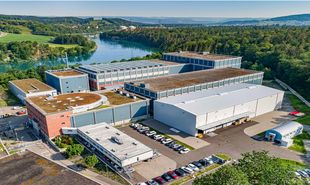 Zwilag in Aargau
Regulations in Switzerland are based on international rules governing the transport of dangerous goods. Permits for the transport of nuclear material are issued by the Federal Office of Energy. The Federal Office of Energy's permit is based on a safety assessment by the Swiss Federal Nuclear Safety Inspectorate (ENSI).
A deep geological repository requires structures on the Earth's surface. All these structures together constitute the surface infrastructure. The most prominent of these infrastructures are the facilities at the portal of the repository tunnel, the so-called surface facilities, and the secondary access facilities for construction and ventilation. The development of these facilities (e.g., a transshipment terminal) and areas temporarily required for the construction of the repository (e.g., an installation site, an excavated material storage area) are also considered part of the surface infrastructure.
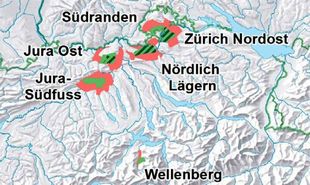 Sites examined
In Stage 1, suitable site areas were identified based on safety and geological criteria. Nagra proposed three site areas for high-level radioactive waste and six for low- and intermediate-level radioactive waste. These were then reviewed and approved by the Swiss Federal Nuclear Safety Inspectorate (ENSI). The sites were: Jura East, Northern Lägern, and Zurich Northeast (each for both waste types), Jura South Foothills, Southern Randen, and Wellenberg (each for low- and intermediate-level waste only). The six site areas were approved by the Federal Council and included in the Sectoral Plan. Regional conferences were established at the end of Stage 1 to facilitate participation from the host regions.
In Stage 2, Nagra worked with the regional conferences on the placement and design of the respective site areas for surface facilities. The required area varies depending on the region and proposal, ranging from 14 to 24 hectares (see tables below). With the Federal Council's decision on Stage 2, the site areas for surface facilities were determined. In the ongoing Stage 3, these locations can be further optimized. In addition, the locations for the secondary access facilities are being discussed and finalized.
The transport of nuclear waste is subject to the strictest safety criteria. Special containers have been developed to transport spent fuel elements and highly radioactive vitrified waste from nuclear facilities (e.g., nuclear power plants) to their interim storage facilities. They are designed to shield radiation and prevent the release of radioactivity.
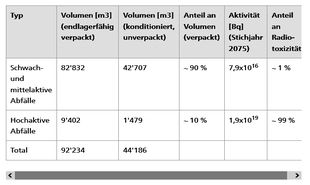 Waste quantities
The graphic shows waste according to the 2016 disposal program for a 60-year operating period of the existing nuclear power plants, Mühleberg (47 years).
For fuel rods that are still generating heat, the containers have cooling fins. The base and steel lid are equipped with shielding polyethylene plates. The lid system typically consists of a so-called two-barrier sealing system (a primary and a secondary lid), onto which a third protective lid is placed during storage. Both the lid and base of the container are protected during transport by large steel shock absorbers filled with shock-absorbing materials (e.g., wood). These shock absorbers are approximately six meters long, have a diameter of about two meters, and can weigh up to 150 tons when loaded.
In drop tests, containers had to be dropped from a height of nine meters onto an unyielding foundation in such a way as to cause maximum damage. In the second drop test, the container was dropped from a height of one meter onto a solid steel spike 15 centimeters in diameter and 20 centimeters high. Here, too, the container was positioned in various ways to induce maximum damage.
For lightweight containers up to 500 kilograms in mass and with a specific gravity of less than 1000 kilograms per cubic meter, additional crush tests were performed. In these tests, a 500-kilogram weight is dropped from a height of nine meters onto the container, which is resting on a rigid foundation.
live stream of the press conference on Nagra's preferred location for the deep geological repository will be available here from 9 a.m. on Monday, September 12
Sources: