WAGNER Switzerland AG




German technology remains highly regarded when it comes to rapid material handling, the elimination of weaknesses, and service quality. Following successful projects in Oklahoma and Texas, the steel trader " Steel and Pipe Supply " (SPS) in Kansas City once again relied on Kasto saws and storage systems.

Bito is launching an offensive with an economical alternative for companies that want to re-equip, expand, or temporarily supplement their warehouse and production areas, but don't want to tie up their capital long-term: renting instead of buying is the motto. The advantages – especially in " dynamic times " – are obvious.

Logistics provider Yusen is presenting an expanded global platform for the healthcare sector at LogiPharma in Vienna, where companies such as Novartis, Bayer, Takeda, and hospital supplier UCB are currently participating. The platform focuses on the professional delivery of specialized healthcare solutions.

Coop's own rail connection for urban logistics in Zurich, streamlined logistics vehicles and the outsourcing of all operating room logistics in a cooperation between the Seeschau Clinic and the Swiss Post are the projects that are entering the final sprint for this year's Swiss Logistics Award from GS1.

Compressed air has traditionally been used primarily for fixed installations. Schmalz's vacuum grippers also mainly operate with lines that often have to run across halls and facilities. However, mobile robotics increasingly requires flexible solutions – a need that Schmalz now intends to address more effectively.

Safelog, the specialists for software for controlling intralogistics processes, have entered into a cooperation with the drive experts from SEW Eurodrive at LogiMAT in order to jointly develop a high-performance software for controlling mobile and stationary processes in intralogistics.

“Never walk alone” could be the motto of a networking event hosted by the consulting experts from “Adnovum”, where the Digital Product Passport (DPP), cybersecurity and IT opportunities with Petra Merino (GS1 Switzerland) and security expert Andreas Achterholt are on the agenda on May 7th in Zurich.

With a new workshop in Obersiebenbrunn near Vienna, rail manufacturer Stadler is expanding its capacity for the commissioning, approval, and servicing of modern rail vehicles in Austria. The workshop has been used to maintain Westbahn's high-speed trains since March 2026.

Idealworks, part of the Munich-based Agile Robots Group, with more than 1,700 AMRs and AGVs worldwide and one of the pioneers in industrial automation through AI in robot-controlled logistics processes, has founded a US company headquartered in Greenville, South Carolina.

At LogiMAT, conveyor technology provider Interroll attracted attention with a new chain-belt sorting system developed after the acquisition of Sortteq. Together with MCP Play, this creates a material flow ecosystem that combines single-item transport with intelligent sorting.
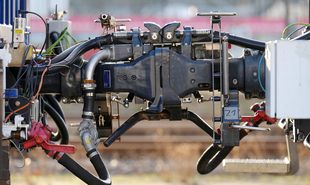 Photo: DB
Deutsche Bahn (DB) intends to significantly accelerate the expansion of its infrastructure. With track construction capacities exhausted, digitalization and the train control systems ETCS and ERTMS are expected to provide relief, with Stuttgart and the Rhine Valley corridor in particular benefiting from faster service intervals and an additional €1 billion.
In Berlin, an existing financing agreement for the digitalization of the railways has been increased from approximately €1.7 billion to approximately €2.7 billion. The funds now provided will be used, among other things, for the modernization and digitalization of the infrastructure on the Rhine-Alpine freight corridor. This main line, running from the Dutch North Sea ports to Italy, is to be equipped with the European Rail Traffic Management System (ERTMS). The system will significantly facilitate cross-border train traffic in Europe. Currently, locomotives, unless already equipped with multi-system technology like those used by BLS Cargo, must be fitted with a variety of national safety systems. With ERTMS, this will no longer be necessary.
Furthermore, Deutsche Bahn (DB) intends to invest approximately €307 million in further planning for the Scandinavian-Mediterranean Corridor (ScanMed). This European corridor, also crucial for freight transport, is slated to be fully equipped with ETCS (European Train Control System) between Denmark and Austria by the end of 2030. This involves a total of 4,500 kilometers of track. DB states that intelligently networked data from infrastructure and vehicles will enable it to "completely reorganize" operations on the rail network and create up to 35 percent more capacity. However, this target assumes that all existing technologies will be replaced by the new electronic control system.
A further 83 million euros are available for planning the third component of the Stuttgart Digital Hub. By 2030, train operations in the Stuttgart metropolitan area, extending beyond the termini of the S-Bahn lines, are to be controlled by digital technology. The core of the hub, along with the Stuttgart 21 project, will go into operation in 2025 using ETCS without signals – thus, it is said, the metropolitan region will assume a "global pioneering role".
Around eleven million euros in planning funds are earmarked for the Cologne–Frankfurt/Main high-speed rail line. By 2028, Deutsche Bahn (DB) plans to equip approximately 200 kilometers of track with ETCS and digital signal boxes. This step will ensure greater quality and efficiency in train operations. At the same time, it will allow for the complete replacement of failure-prone systems and older signal boxes.
www.bmdv.bund.de