
WAGNER Switzerland AG






German technology remains highly regarded when it comes to rapid material handling, the elimination of weaknesses, and service quality. Following successful projects in Oklahoma and Texas, the steel trader " Steel and Pipe Supply " (SPS) in Kansas City once again relied on Kasto saws and storage systems.

Bito is launching an offensive with an economical alternative for companies that want to re-equip, expand, or temporarily supplement their warehouse and production areas, but don't want to tie up their capital long-term: renting instead of buying is the motto. The advantages – especially in " dynamic times " – are obvious.

Logistics provider Yusen is presenting an expanded global platform for the healthcare sector at LogiPharma in Vienna, where companies such as Novartis, Bayer, Takeda, and hospital supplier UCB are currently participating. The platform focuses on the professional delivery of specialized healthcare solutions.

Coop's own rail connection for urban logistics in Zurich, streamlined logistics vehicles and the outsourcing of all operating room logistics in a cooperation between the Seeschau Clinic and the Swiss Post are the projects that are entering the final sprint for this year's Swiss Logistics Award from GS1.

Compressed air has traditionally been used primarily for fixed installations. Schmalz's vacuum grippers also mainly operate with lines that often have to run across halls and facilities. However, mobile robotics increasingly requires flexible solutions – a need that Schmalz now intends to address more effectively.

Safelog, the specialists for software for controlling intralogistics processes, have entered into a cooperation with the drive experts from SEW Eurodrive at LogiMAT in order to jointly develop a high-performance software for controlling mobile and stationary processes in intralogistics.

“Never walk alone” could be the motto of a networking event hosted by the consulting experts from “Adnovum”, where the Digital Product Passport (DPP), cybersecurity and IT opportunities with Petra Merino (GS1 Switzerland) and security expert Andreas Achterholt are on the agenda on May 7th in Zurich.

With a new workshop in Obersiebenbrunn near Vienna, rail manufacturer Stadler is expanding its capacity for the commissioning, approval, and servicing of modern rail vehicles in Austria. The workshop has been used to maintain Westbahn's high-speed trains since March 2026.

Idealworks, part of the Munich-based Agile Robots Group, with more than 1,700 AMRs and AGVs worldwide and one of the pioneers in industrial automation through AI in robot-controlled logistics processes, has founded a US company headquartered in Greenville, South Carolina.

At LogiMAT, conveyor technology provider Interroll attracted attention with a new chain-belt sorting system developed after the acquisition of Sortteq. Together with MCP Play, this creates a material flow ecosystem that combines single-item transport with intelligent sorting.
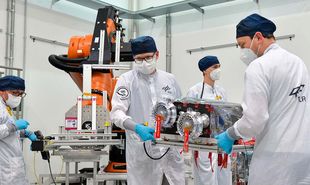
The rover, which is scheduled to explore the 27 km Martian moon Phobos in 2024, will likely only be able to right itself under extremely weak gravity conditions by performing several somersaults. Its main components were delivered this week from Bremen to the French CNES research center in Toulouse.
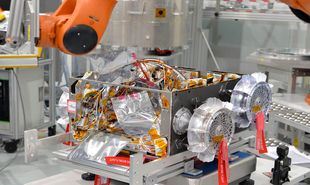
The German Aerospace Center (DLR) integrated and completed key components of the rover at its Bremen site this week. The carbon fiber structure, developed through collaboration between several DLR institutes, placed high demands on the onboard righting and propulsion system. "With the MMX rover, we are breaking new ground technologically, as no wheeled exploration vehicle has ever before traveled on a small celestial body with only about one-thousandth of Earth's gravity," says Markus Grebenstein, project manager at the DLR Institute of Robotics and Mechatronics in Oberpfaffenhofen. Since the rover will fall from the spacecraft to Phobos, it will perform several somersaults upon landing – without sustaining further damage – and come to rest in an unpredictable position. "From this position, it must autonomously right itself using its propulsion system and then deploy its solar panels. Only then will the rover be ready to drive and capable of survival," Grebenstein explains. “Ultimately, it will drive very carefully at only a few millimeters per second in order to maintain contact with the ground despite the low gravity using its special wheels,” adds Stefan Barthelmes from the DLR Institute of System Dynamics and Control in Oberpfaffenhofen.

The origin of the two Martian moons Phobos and Deimos remains a mystery. To solve this puzzle, the Japanese space agency JAXA will launch the Martian Moons eXploration (MMX) mission to the two moons in 2024.
Upon arrival at Phobos, the MMX rover, weighing only 25 kg, will detach from the MMX mothership and drop approximately 50 meters to the lunar surface. This was already tested in initial drop tests at the DLR Institute of Space Systems in Bremen, where the rover was also integrated. On Phobos, the rover will have around 100 days to explore the physical and mineralogical properties of the surface. Two DLR instruments, miniRAD and RAX, from Berlin, will be used for this purpose. The miniRAD radiometer from the Institute of Planetary Research will determine the surface temperature using infrared measurements. It will also allow conclusions to be drawn about the porosity of the surface material, enabling comparisons with asteroid and comet samples. The Raman spectrometer RAX (RAman spectroscopy for MMX) is a development led by the Institute for Optical Sensor Systems with the participation of JAXA and the Spanish space agency INTA. RAX will determine the mineralogical composition of the Phobos surface along the rover's route.
“Fear” and “Terror”
In addition to the two DLR instruments, two wheel cameras will be installed at CNES in Toulouse in the coming months. These cameras will monitor the wheels and the terrain, collecting scientific data on the structure of Phobos’ surface, and two navigation cameras will also be integrated. Furthermore, the engineering teams will install the solar panels, the power system, the radio system for contact with Earth, and the onboard computer into the rover. Extensive tests of the complete rover will then be carried out to assess its functionality and its resistance to the vibrations of the rocket launch and the extreme temperature fluctuations of more than 200 °C on Phobos.
 Photos: DLR
The MMX rover will undergo tests under space conditions together with the connection and separation system to the mothership, called "MECss" (Mechanical and Electrical Connection and Support System).
The MMX spacecraft consists of three modules. The exploration module has landing legs, samplers, and several instruments, as well as the MMX rover. The return module, containing the sample return capsule, is attached to the exploration module, followed by a propulsion module with the fuel tanks and rocket engines.
Approximately one year after leaving Earth, the probe will enter orbit around Mars in 2025 to observe Phobos and Deimos. It will then enter a quasi-orbit around the Martian moon Phobos, collect scientific data, deploy the MMX rover, and collect samples from the lunar surface. After sample collection, the spacecraft will return to Earth with the material gathered on Phobos. The MMX rover is scheduled to land on Phobos in 2027 and return to Earth with the samples in 2029.
Phobos and Deimos (meaning "fear" and "death" in Greek) are small moons orbiting Mars. They were discovered in 1877 by the American astronomer Asaph Hall. After the launch of the MMX mission, the rover will be operated from control centers at CNES in Toulouse, France, and DLR in Cologne, Germany.