WAGNER Switzerland AG





German technology remains highly regarded when it comes to rapid material handling, the elimination of weaknesses, and service quality. Following successful projects in Oklahoma and Texas, the steel trader " Steel and Pipe Supply " (SPS) in Kansas City once again relied on Kasto saws and storage systems.

Bito is launching an offensive with an economical alternative for companies that want to re-equip, expand, or temporarily supplement their warehouse and production areas, but don't want to tie up their capital long-term: renting instead of buying is the motto. The advantages – especially in " dynamic times " – are obvious.

Logistics provider Yusen is presenting an expanded global platform for the healthcare sector at LogiPharma in Vienna, where companies such as Novartis, Bayer, Takeda, and hospital supplier UCB are currently participating. The platform focuses on the professional delivery of specialized healthcare solutions.

Coop's own rail connection for urban logistics in Zurich, streamlined logistics vehicles and the outsourcing of all operating room logistics in a cooperation between the Seeschau Clinic and the Swiss Post are the projects that are entering the final sprint for this year's Swiss Logistics Award from GS1.

Compressed air has traditionally been used primarily for fixed installations. Schmalz's vacuum grippers also mainly operate with lines that often have to run across halls and facilities. However, mobile robotics increasingly requires flexible solutions – a need that Schmalz now intends to address more effectively.

Safelog, the specialists for software for controlling intralogistics processes, have entered into a cooperation with the drive experts from SEW Eurodrive at LogiMAT in order to jointly develop a high-performance software for controlling mobile and stationary processes in intralogistics.

“Never walk alone” could be the motto of a networking event hosted by the consulting experts from “Adnovum”, where the Digital Product Passport (DPP), cybersecurity and IT opportunities with Petra Merino (GS1 Switzerland) and security expert Andreas Achterholt are on the agenda on May 7th in Zurich.

With a new workshop in Obersiebenbrunn near Vienna, rail manufacturer Stadler is expanding its capacity for the commissioning, approval, and servicing of modern rail vehicles in Austria. The workshop has been used to maintain Westbahn's high-speed trains since March 2026.

Idealworks, part of the Munich-based Agile Robots Group, with more than 1,700 AMRs and AGVs worldwide and one of the pioneers in industrial automation through AI in robot-controlled logistics processes, has founded a US company headquartered in Greenville, South Carolina.

At LogiMAT, conveyor technology provider Interroll attracted attention with a new chain-belt sorting system developed after the acquisition of Sortteq. Together with MCP Play, this creates a material flow ecosystem that combines single-item transport with intelligent sorting.
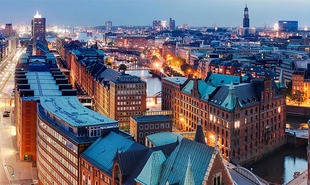
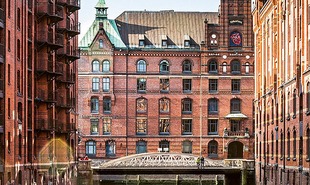
Hamburg's Speicherstadt (warehouse district) is not only a UNESCO World Heritage Site, but also a valuable resource in terms of its architectural heritage. A pioneering research project aims to determine whether this world-famous warehouse landscape can be renovated to achieve climate neutrality.
Built between 1885 and 1927 and stretching 1.1 km, Speicherstadt is the world's largest contiguous warehouse complex. It has been a listed building since 1991 and, as a UNESCO World Heritage Site since 2015, is subject to particularly stringent preservation regulations. Today, trading companies, fashion agencies, and start-ups are vying for rental space in the district. Of the total 450,000 square meters of gross floor area, the owner, HHLA Immobilien, currently leases 300,000 square meters.
As part of the project, dubbed "CO2-Neutral World Heritage Site Speicherstadt Hamburg," construction specialists from universities are cooperating closely with experts from the port operator HHLA. The buildings are being transformed into research objects. The question of how the energy stored in existing buildings by their original construction—the so-called "inherent" energy—can be further utilized without demolishing anything and constructing significantly cheaper new buildings is currently being widely discussed in Germany as well. Every demolition means the waste of large quantities of still usable material , according to HHLA.
The so-called "embodied energy," which remains stored in a building until it is demolished, accounts for an average of 50 percent of the energy consumed over its entire life cycle. Therefore, the longer a building is used, the better it is for the climate.
The Speicherstadt (warehouse district) is to be transformed into an energy-efficient, CO2-neutral neighborhood by 2040. The "CO2-Neutral World Heritage Speicherstadt" project has actually been underway since 2021 and is scheduled for completion by the end of 2024. It is financially supported by the Federal Ministry for Economic Affairs and Climate Action, and the project management agency is Forschungszentrum Jülich. The research consortium includes the University of Stuttgart with its Institute for Building Materials, the Chair of Structural Design and Analysis at HafenCity University Hamburg, and RWTH Aachen University with its Chair of Building and Indoor Climate Technology.
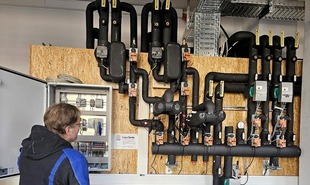
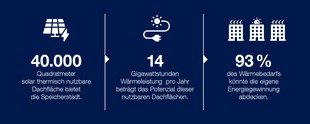
The " Sandtorkaispeicher " or " Block H " serves as a pilot project. Here, researchers are investigating how an entire block within the UNESCO World Heritage Site can be supplied with heat autonomously and emission-free solely through the use of existing roof surfaces – without compromising the appearance of the historic roofs. The research project encompasses the generation of solar electricity and solar thermal energy, the storage of heat using various methods in the basement, and the distribution and regulation of energy within the building using a heat pump. The efficiency of this experimental system is tested and measured in the research workshop on the ground floor. Meeting rooms and corridors are equipped as a model open-plan office with modern insulation and heating technology.
 All photos: HHLA
On the roof, two structures made of wooden rafters were erected on a steel tube frame and covered with "solar hybrid roof systems"—imitations of slate shingles, indistinguishable from the original roof elements to the naked eye—which do not detract from the historical appearance through light reflections or color effects of conventional solar cells. "They consist neither of slate nor copper, but of glass," explains Professor Harald Garrecht from the University of Stuttgart. The sun's UV rays penetrate a transparent layer to generate both electricity and solar thermal energy.
Each module is connected to a system of copper pipes running underneath, through which a frost-protected mixture of water and glycol flows, transporting heat to the interior of the block. Simultaneously, cold fluid is circulated from below to heat the module. The electricity produced emission-free by the hybrid DAC modules powers the climate-neutral operation of the test facility. Besides the control electronics, the largest energy consumer is a heat pump at the center of the system. The electricity and heat output under various weather conditions and seasons will be measured and evaluated until the end of 2024.
In the basement, two thermal energy storage systems operate based on different physical principles: an ice storage system and a concrete storage system. The hybrid concrete storage system has a solid-filled core through which water flows, and is well insulated. Heat generated on the roof in summer, reaching up to 70 degrees Celsius, can be stored in this heated core for a medium period, thus providing the storage system's office spaces with flexible heat for weeks during transitional seasons.
The twelve cells of this newly developed type of ice storage system utilize the phenomenon of "phase change": A heat exchanger extracts energy from the water in the ice storage until it freezes. The phase thus changes from liquid to solid, resulting in a surge of latent heat energy. This, the engineers say, can then be used via a heat pump to supply the underfloor heating.
Meanwhile, the roof-mounted solar panels warm the fluid running through the pipes between the roof and the ice storage tank. This fluid is then piped down to the basement, used to melt the ice block – and the cycle can begin again. The thermal energy from the ice storage tank, which yields approximately 93 kWh per cubic meter of water, can be harvested once or twice a week. This is equivalent to the heat output of 9.3 liters of heating oil.
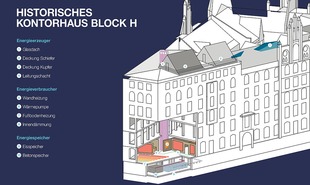
The distribution point on the ground floor is a complex network of pipes, controllers, sensors, and valves. These are connected to a refrigerator-sized box: the central heat pump. Here, the pipes to and from all components of the energy system converge: from the two energy sources, solar power and solar thermal on the roof, the heat flows from the ice and concrete hybrid storage tanks, as well as the supply and return pipes of the underfloor heating in the open-plan experimental office.
How efficient all of this is in reality, the scientists admit, is – likewise – uncharted scientific territory. The model experiment is intended to provide reliable data, explains Peter Rosenzweig, project manager at HHLA.
The full report by Oliver Driesen can be found here.