WAGNER Switzerland AG




German technology remains highly regarded when it comes to rapid material handling, the elimination of weaknesses, and service quality. Following successful projects in Oklahoma and Texas, the steel trader " Steel and Pipe Supply " (SPS) in Kansas City once again relied on Kasto saws and storage systems.

Bito is launching an offensive with an economical alternative for companies that want to re-equip, expand, or temporarily supplement their warehouse and production areas, but don't want to tie up their capital long-term: renting instead of buying is the motto. The advantages – especially in " dynamic times " – are obvious.

Logistics provider Yusen is presenting an expanded global platform for the healthcare sector at LogiPharma in Vienna, where companies such as Novartis, Bayer, Takeda, and hospital supplier UCB are currently participating. The platform focuses on the professional delivery of specialized healthcare solutions.

Coop's own rail connection for urban logistics in Zurich, streamlined logistics vehicles and the outsourcing of all operating room logistics in a cooperation between the Seeschau Clinic and the Swiss Post are the projects that are entering the final sprint for this year's Swiss Logistics Award from GS1.

Compressed air has traditionally been used primarily for fixed installations. Schmalz's vacuum grippers also mainly operate with lines that often have to run across halls and facilities. However, mobile robotics increasingly requires flexible solutions – a need that Schmalz now intends to address more effectively.

Safelog, the specialists for software for controlling intralogistics processes, have entered into a cooperation with the drive experts from SEW Eurodrive at LogiMAT in order to jointly develop a high-performance software for controlling mobile and stationary processes in intralogistics.

“Never walk alone” could be the motto of a networking event hosted by the consulting experts from “Adnovum”, where the Digital Product Passport (DPP), cybersecurity and IT opportunities with Petra Merino (GS1 Switzerland) and security expert Andreas Achterholt are on the agenda on May 7th in Zurich.

With a new workshop in Obersiebenbrunn near Vienna, rail manufacturer Stadler is expanding its capacity for the commissioning, approval, and servicing of modern rail vehicles in Austria. The workshop has been used to maintain Westbahn's high-speed trains since March 2026.

Idealworks, part of the Munich-based Agile Robots Group, with more than 1,700 AMRs and AGVs worldwide and one of the pioneers in industrial automation through AI in robot-controlled logistics processes, has founded a US company headquartered in Greenville, South Carolina.

At LogiMAT, conveyor technology provider Interroll attracted attention with a new chain-belt sorting system developed after the acquisition of Sortteq. Together with MCP Play, this creates a material flow ecosystem that combines single-item transport with intelligent sorting.
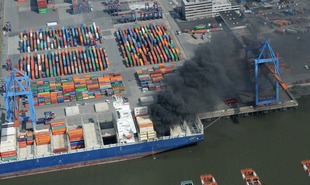 Photo: Hamburg Police
Until now, checks in the Port of Hamburg to determine whether someone was carrying hazardous materials were largely manual and based on random samples. Now, the water police have introduced a digital model that uses artificial intelligence (AI) to systematically detect undeclared hazardous materials.
The new digital application uses algorithms to generate recommendations for containers to be inspected during import and export. Based on the lists of suggestions generated by the AI, the water police officers check the identified cargo units.
“Given the high number of containers, checks have so far only been possible on a case-by-case basis,” says Lutz Dreyer, head of department at the Water Police WSP 52, Central Hazardous Goods Monitoring Unit. A specialist analysis in 2021 showed that the search for undeclared hazardous goods could be significantly improved and made more efficient by incorporating intelligent methods, particularly from the field of artificial intelligence (AI).
“We launched the AI project at the beginning of 2023 with financial support from the Hamburg Senate Chancellery’s InnoTecHH fund and technical support from Dakosy,” says Dreyer. To systematically identify undeclared hazardous materials, the authority first needed digital access to all export and import shipment information for the containers handled at the Port of Hamburg. This information is available in the Port Community System (PCS), which is operated by the software providers.
By the end of 2023, import data, and by the end of April 2024, export data from the PCS (Project Control System) were integrated into the Water Police's digital dangerous goods information system (GEGIS) and trained with AI. "The shipments were marked with a probability factor for undeclared dangerous goods and checked by us," explains Dreyer. Thilo Buchheister, who heads the project, adds: "We use a deep learning model for the automated, regular training procedures, which allows us to also include new aspects, such as additional product descriptions, in the analysis."
The foundation for the AI project was laid by the revision of Hamburg's Port Security Act. There was a slight problem: only the new version allows the Water Protection Authority to process cargo data to determine whether undeclared hazardous materials are being loaded or unloaded in transport units in the Port of Hamburg. Previously, the Water Protection Authority lacked the legal basis to systematically inspect containers that were not declared as hazardous materials.
Olaf Hagenloch, deputy head of the Hamburg Water Police, recalls a tragic event in this context: "Many of us still remember the devastating fire on a container ship in 2016, when numerous emergency responders spent several days trying to extinguish the blaze on board. The cause of the fire was undeclared hazardous materials." This demonstrates how crucial it is to label hazardous materials as such. "Thanks to AI support, my colleagues now have an innovative tool at their disposal that significantly enhances both their own safety and the overall safety of the port." They are very grateful for this.
Overall, the newly created framework conditions and the innovative IT technology enable a new level of transparency regarding dangerous goods in day-to-day operations.
“We launched the AI project at the beginning of 2023 with financial support from the InnoTecHH fund of the Hamburg Senate Chancellery and technical support from Dakosy,” says Dreyer. To systematically identify undeclared hazardous materials, the authority needed digital access to all export and import shipment information for the containers handled via the Port of Hamburg.
Stephanie Lützen